Is Employee GPS Tracking Legal? A Country-by-Country Overview

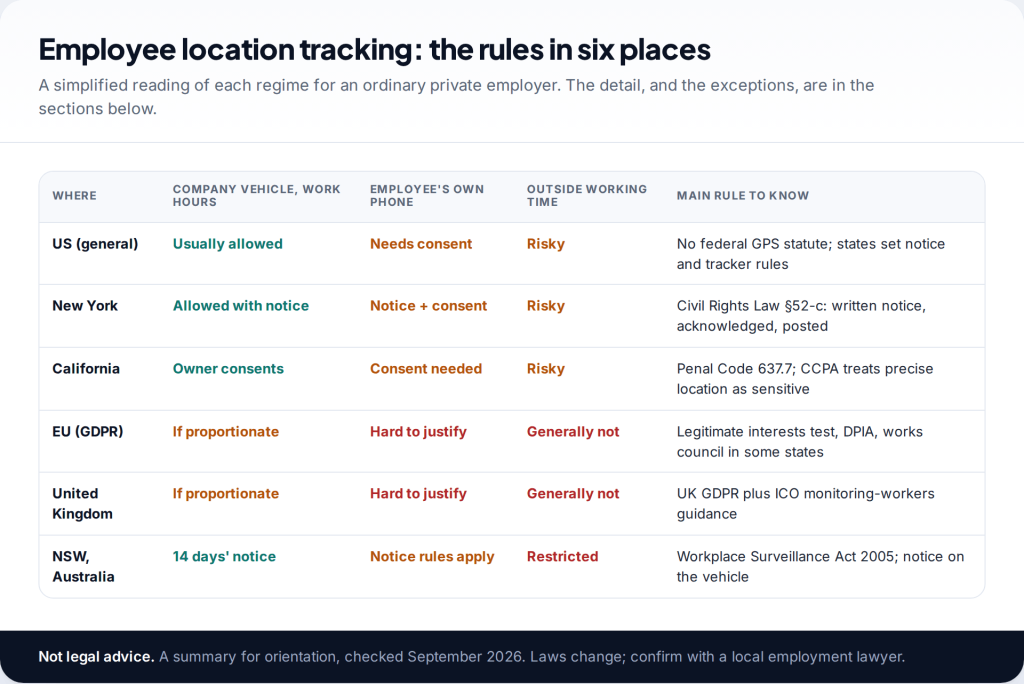
Is employee GPS tracking legal? In most countries, yes, when the employer tracks its own vehicles or devices, during working time, for a stated business reason, and tells staff in advance. It becomes legally risky when an app runs on an employee’s personal phone, when tracking continues after the shift ends, or when it is done without notice. The details differ sharply between US states, the EU, the UK, Canada and Australia.
This is not legal advice. It is a plain-language overview of the main rules as published in September 2026, written to help you ask the right questions. Employment and privacy law changes often, and the answer for your business depends on facts this page cannot see. Check with a qualified employment lawyer in your jurisdiction before you roll out tracking.
Is employee GPS tracking legal? The short answer by region
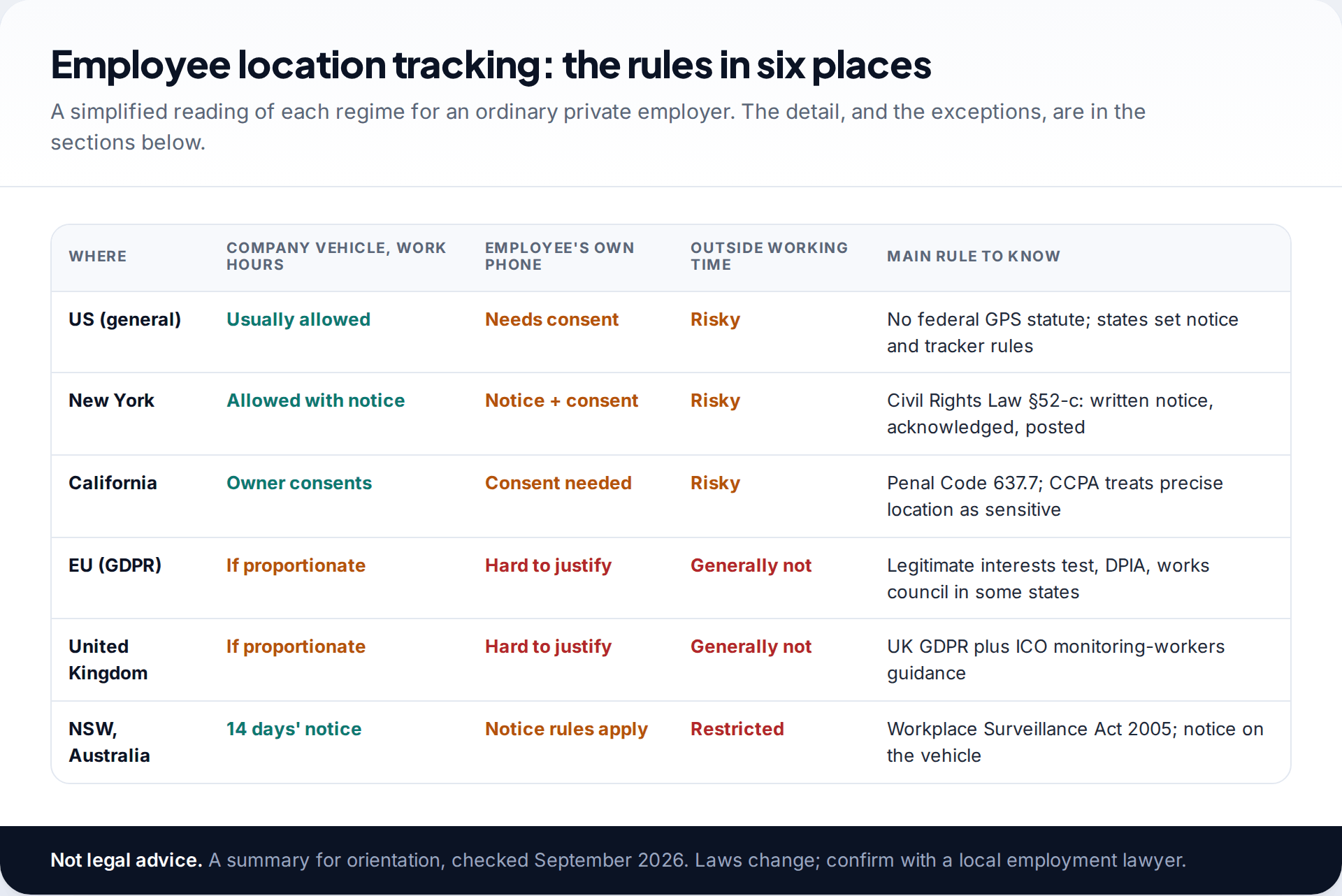
Almost every legal system treats three questions the same way, even when the statutes look nothing alike. Whose device is it? Tracking a van the business owns is much easier to justify than tracking a phone the employee paid for. When does tracking happen? Working hours are defensible; evenings, weekends and holidays usually are not. Were people told? Several jurisdictions make prior written notice a legal requirement, and everywhere else a lack of notice weakens your position.
Where the regimes differ is in how much process they demand before you switch anything on. A small firm in Texas may need little more than a clear policy. The same firm in Germany may need a works council agreement and a documented impact assessment.
United States: no federal GPS law, a patchwork of state rules
There is no federal statute that specifically regulates an employer tracking employees by GPS. The federal wiretap law is aimed at the content of communications, not at location. For public employers the Constitution adds a layer. In Cunningham v. New York State Department of Labor (2013), New York’s highest court held that a state agency acted unreasonably when it tracked an employee’s own car through evenings, weekends and a holiday, even though it had grounds to investigate him. The problem was the scope, not the tracking itself.
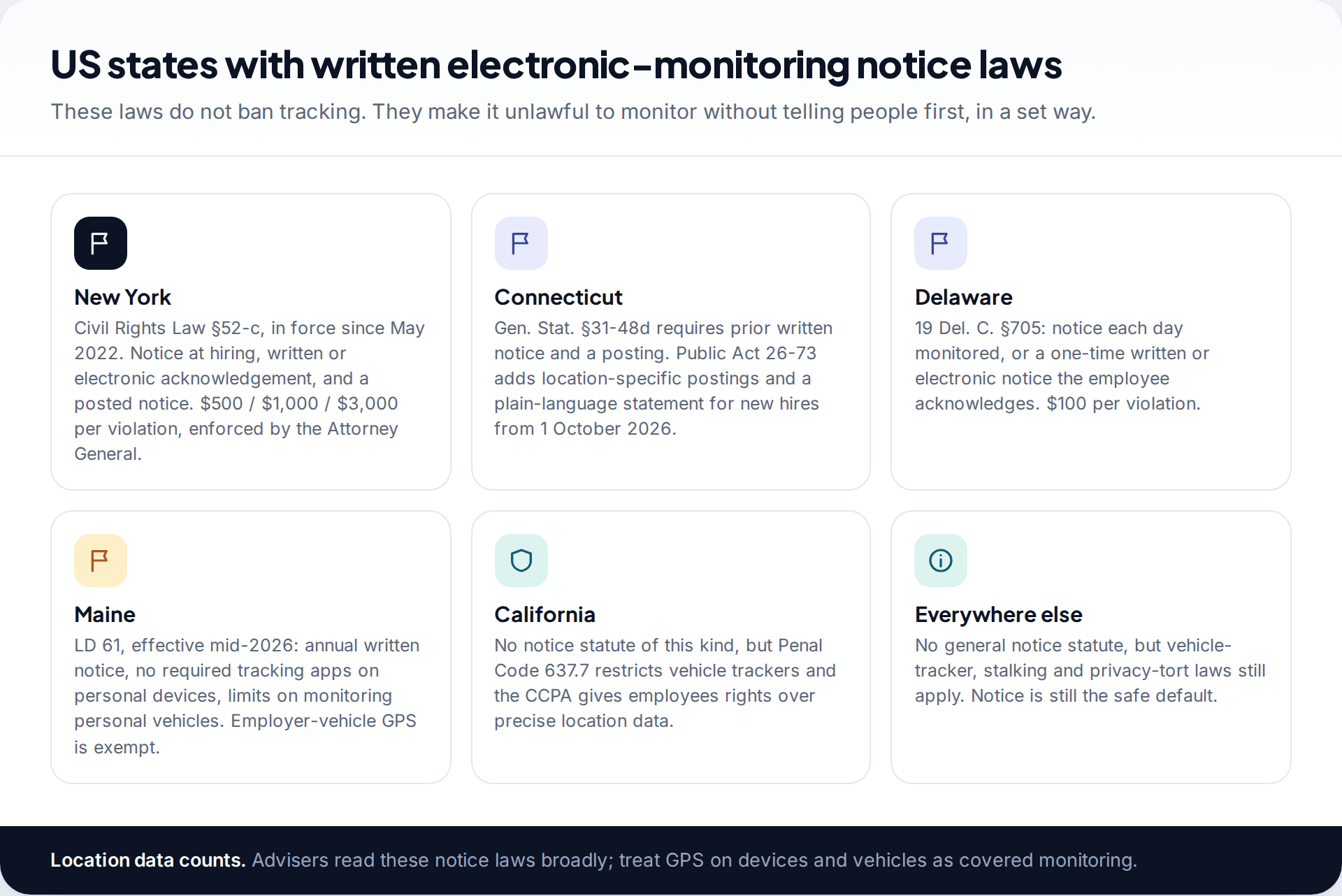
At state level, four laws are the ones to know:
- New York (Civil Rights Law §52-c, in force since May 2022) requires private employers that monitor phone, email or internet use to give written notice at hiring, get a written or electronic acknowledgement, and post the notice where employees can see it. Penalties run from $500 for a first violation to $3,000 for a third, enforced by the state Attorney General; there is no private right to sue.
- Connecticut has required prior written notice of electronic monitoring since 1998. Public Act 26-73, effective 1 October 2026, adds postings at the specific places monitoring happens and a plain-language statement for new hires before they start.
- Delaware lets employers choose between a notice on each day of monitoring or a one-time notice the employee acknowledges. The penalty is $100 per violation.
- Maine passed LD 61 in 2026. It requires notice to applicants and an annual written notice to staff, stops employers requiring data-collecting apps on personal devices, and limits monitoring of personal vehicles and homes. GPS on employer-owned vehicles is exempt.
California works differently. Penal Code 637.7 bars using an electronic tracking device to follow a person, with an exception when the vehicle’s registered owner, lessor or lessee consents. That covers a company fleet, not an employee’s own car. Since January 2023 the California Consumer Privacy Act also applies to employee data held by covered businesses, and it classes precise geolocation as sensitive personal information, which brings disclosure duties and a right to limit its use. Bills to restrict workplace surveillance further, including off-duty tracking, have been debated in Sacramento; check their status before relying on the current position.
Outside these states, several legislatures make it an offence to attach a tracker to someone else’s vehicle without the owner’s consent, and privacy torts such as intrusion upon seclusion remain available to employees. Written notice is the safe default everywhere.
European Union: GDPR, necessity and works councils
The GDPR does not ban employee location tracking, but it sets a high bar. Consent is rarely a valid legal basis at work, because regulators take the view that employees cannot freely refuse their employer. Most employers therefore rely on legitimate interests, which means showing a real purpose, showing that tracking is necessary for it, and balancing that against the worker’s privacy.
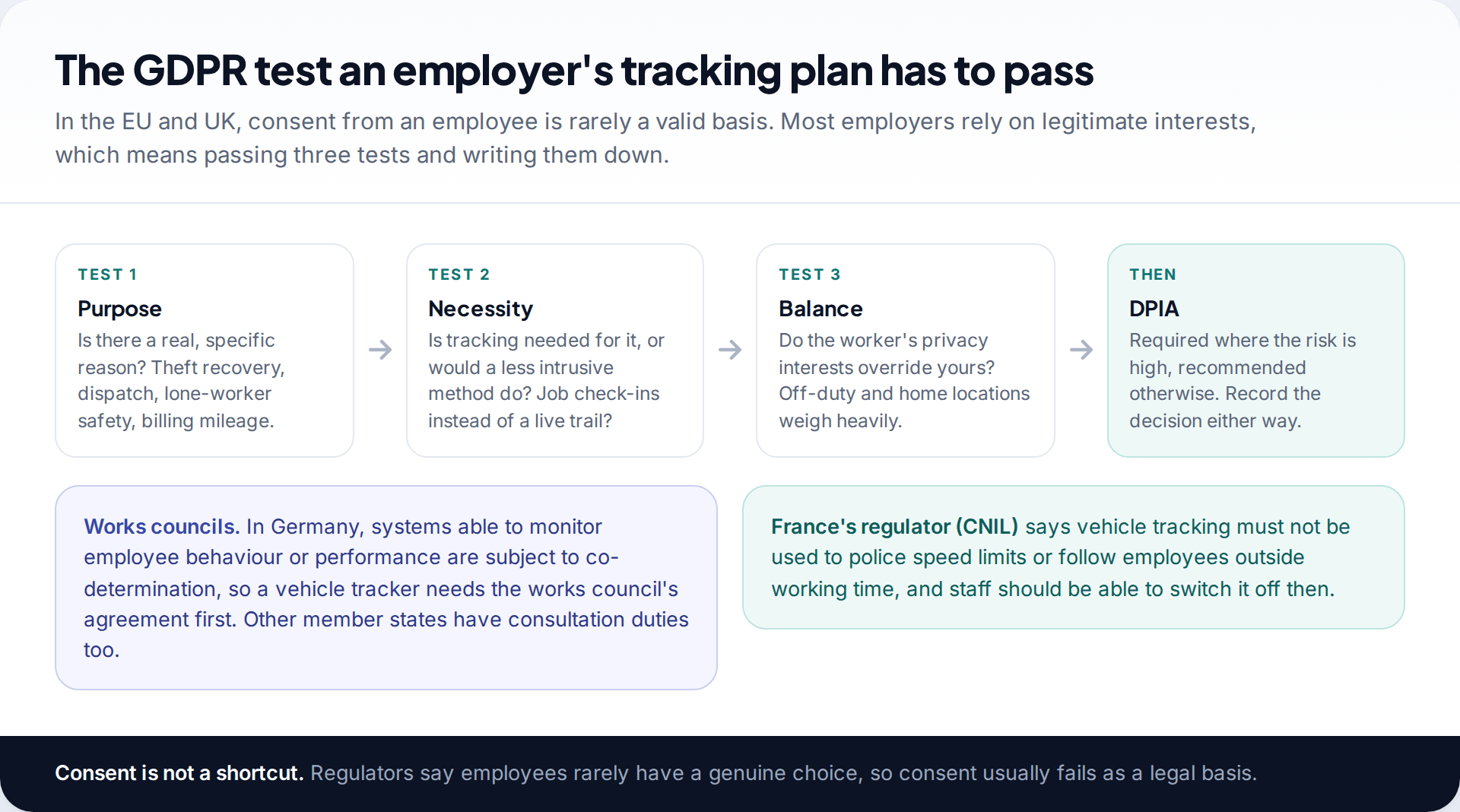
Tracking that could be high risk, such as systematic monitoring of staff, usually calls for a data protection impact assessment (DPIA) before it starts. National rules add more. In Germany, technical systems able to monitor employee behaviour or performance are subject to works council co-determination, so a tracker is typically introduced through a works agreement. France’s regulator, the CNIL, says vehicle tracking must not be used to check speed limits, must not follow employees outside working time, and should in general keep location data for no more than two months (longer only for specific purposes such as proof of work done). Expect similar thinking in other member states even where the rules are less explicit.
United Kingdom: the ICO’s monitoring-workers guidance
The UK follows the same GDPR logic through the UK GDPR and the Data Protection Act 2018. In October 2023 the Information Commissioner’s Office published dedicated guidance on monitoring workers, and it sorts duties into must (the law), should (good practice you need a reason to skip) and could (optional).
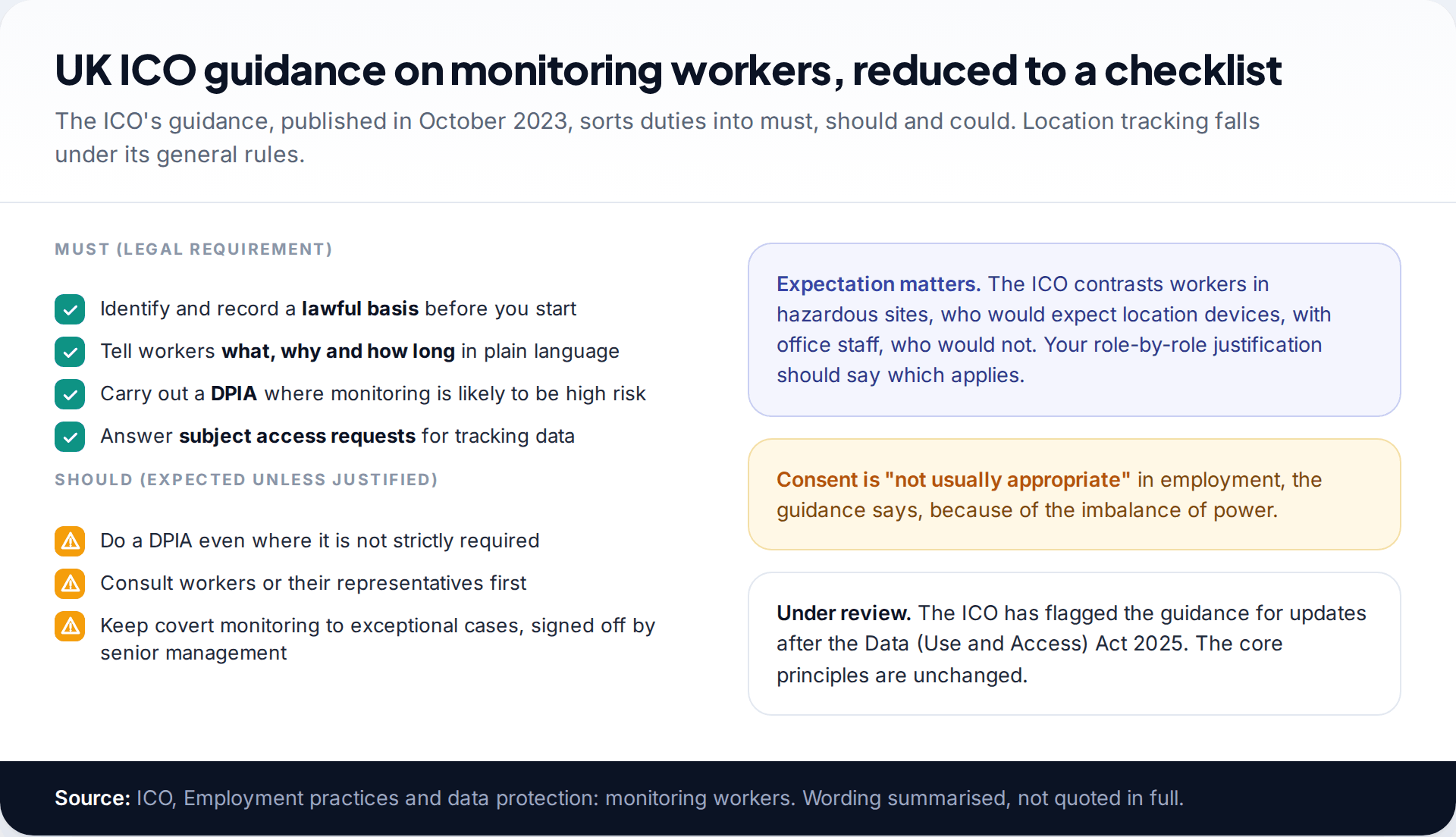
Its practical message for GPS is to match tracking to what the role would reasonably expect. The guidance contrasts workers in hazardous environments, who would expect location devices, with office staff, who would not. It says consent is not usually appropriate for employees, that a DPIA should be done even where one is not strictly required, and that covert monitoring belongs only in exceptional cases such as suspected criminal activity, authorised by senior management and stopped once the investigation ends. The ICO has noted the guidance is under review following the Data (Use and Access) Act 2025.
Canada and Australia
Canada. Ontario’s Employment Standards Act requires employers with 25 or more employees on 1 January to have a written electronic monitoring policy by 1 March, and to give it to staff within 30 days. The policy must say whether and how employees are monitored, and for what purposes. It does not create a new privacy right or forbid monitoring. Federally regulated employers are covered by PIPEDA, and Quebec, Alberta and British Columbia have their own private-sector privacy laws that apply reasonableness tests to employee data.
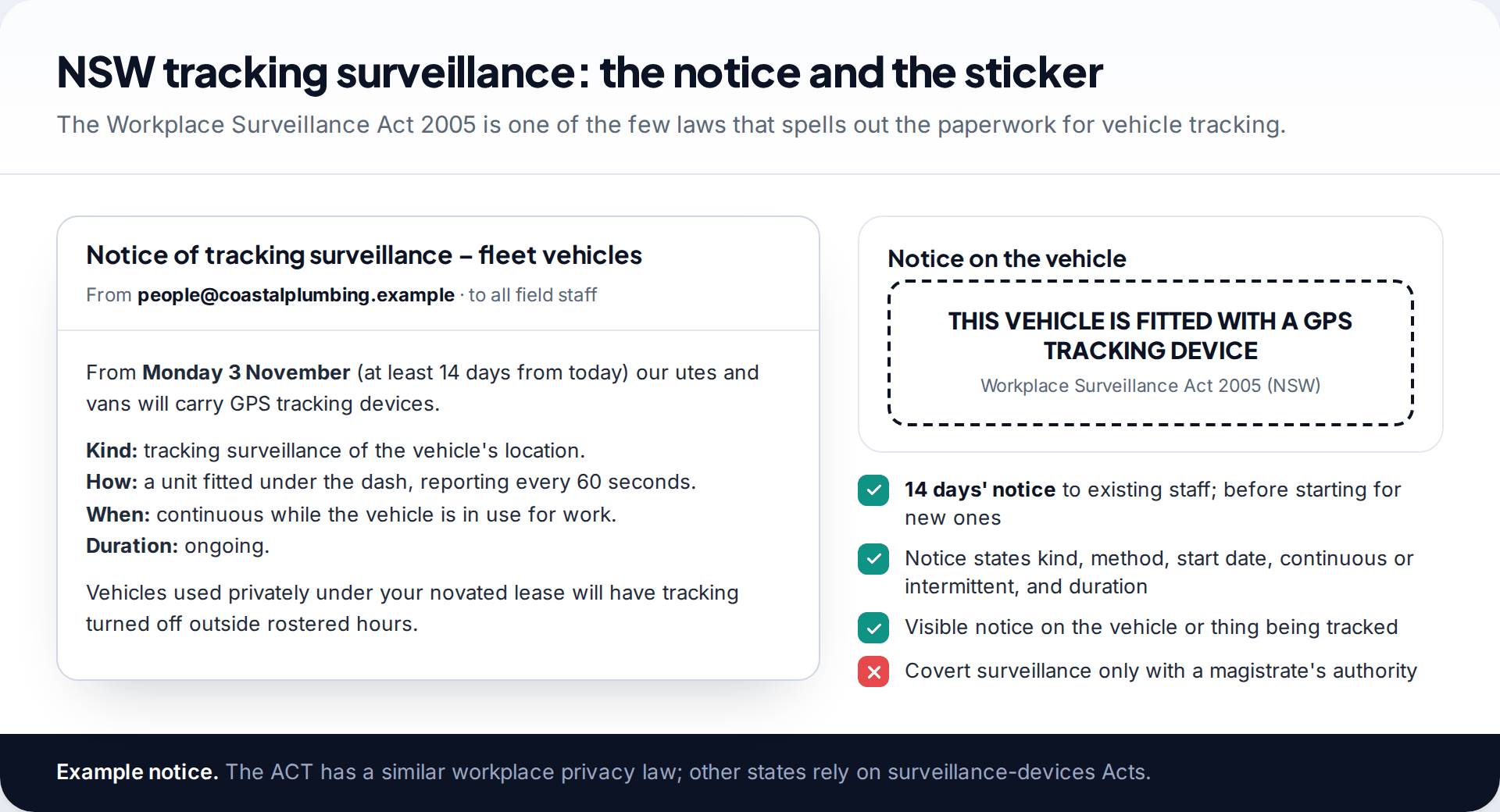
Australia. New South Wales has the most specific law. The Workplace Surveillance Act 2005 requires at least 14 days’ written notice to existing employees before tracking surveillance begins, stating its kind, method, start date, whether it is continuous, and how long it lasts. Tracked vehicles must carry a clearly visible notice. Surveillance of an employee who is not at work is restricted, and covert surveillance needs a magistrate’s authority. The ACT has a comparable Workplace Privacy Act; Victoria and other states regulate tracking devices through surveillance-devices laws.
Company vehicles versus personal phones
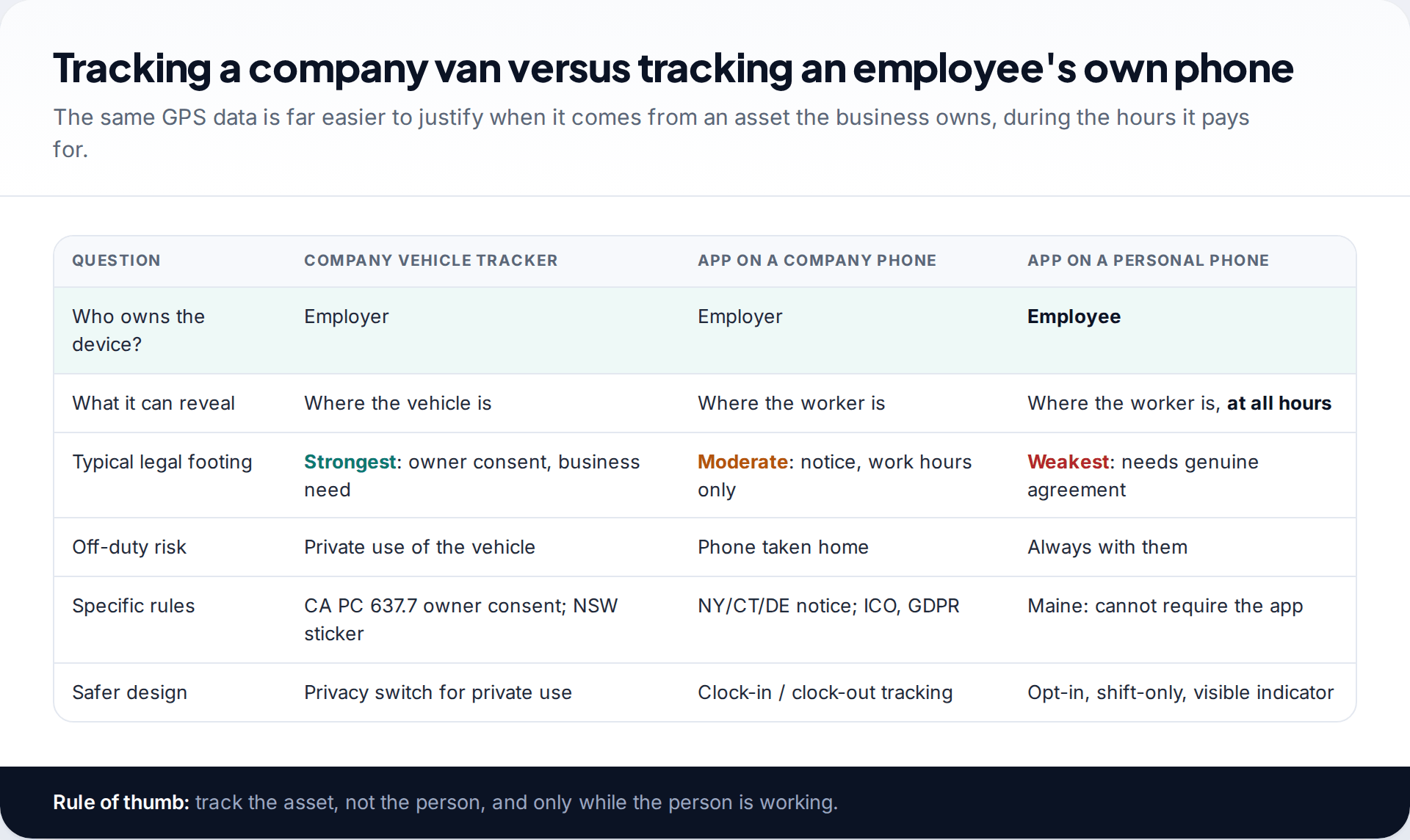
A tracker wired into a company van reveals where the van is. An app on a phone reveals where the person is, including when they stop for lunch at a clinic or drop a child at school. That difference drives most of the law on this page.
If you need location from staff who use their own phones, keep it narrow: an app they opt into, that records only between clock-in and clock-out, and shows clearly when it is active. In Maine you cannot require the app at all, and under GDPR and UK GDPR a personal-phone tracker is hard to justify when a vehicle unit or job check-ins would do. Never install tracking on an employee’s device without their knowledge; apart from the legal exposure, it destroys trust faster than any productivity gain could repay.
Off-hours tracking: where employers most often cross the line
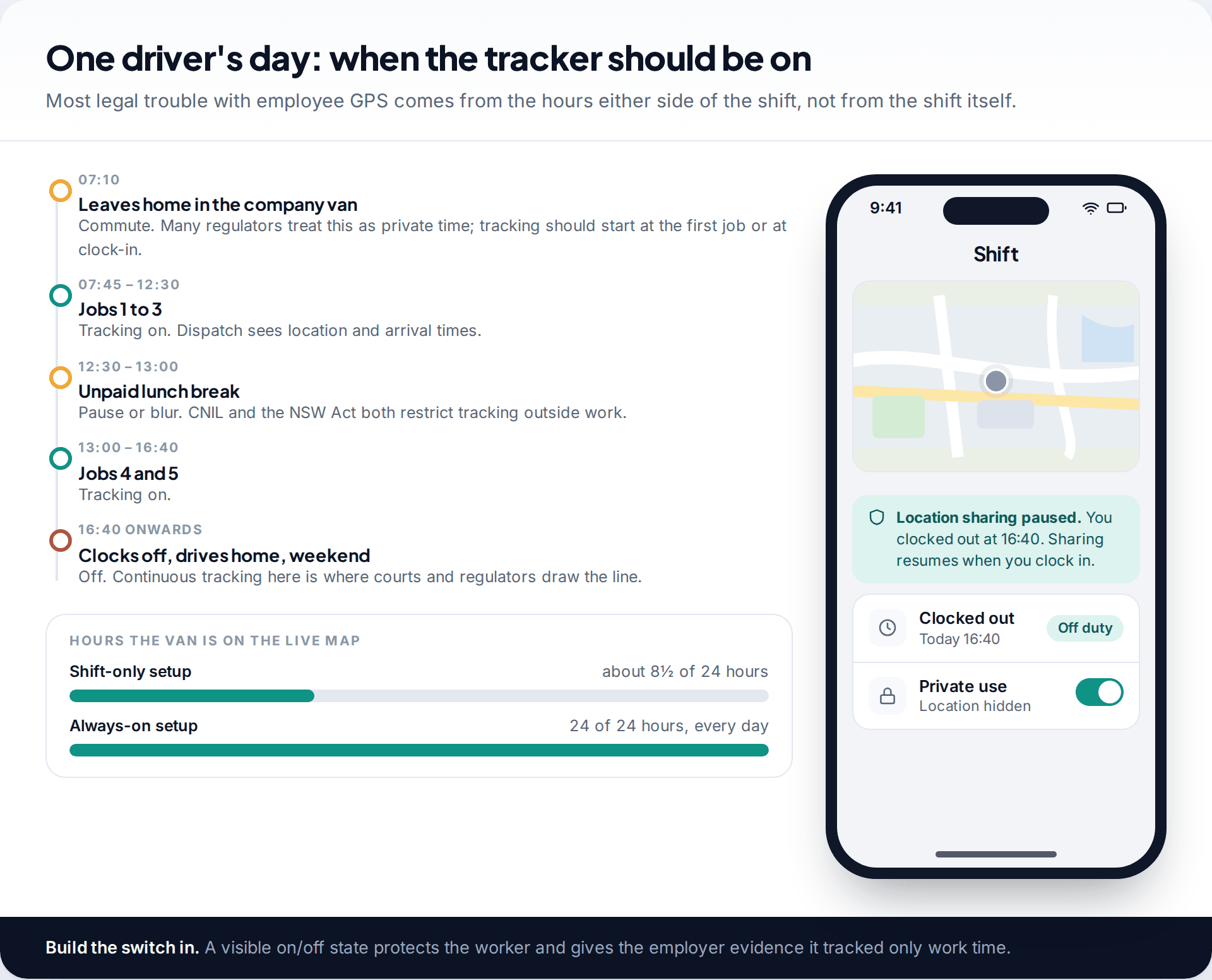
Take-home vehicles are the classic trap. The van is company property, so leaving the tracker on around the clock feels natural. But every regime covered here gives weight to private time. The New York court in Cunningham objected to tracking over weekends and a holiday. The CNIL says employees should be able to disable tracking outside working hours. The NSW Act restricts surveillance of employees who are not at work.
A 12-person plumbing firm with take-home vans
The owner fits trackers for theft recovery and dispatch. Staff drive the vans home and sometimes use them for personal errands with permission. The first draft of the policy shows vans on the live map 24 hours a day.
The revised setup ties tracking to the job app: the map shows each van from first job to last job, a private-use switch hides location outside that window, and theft recovery is handled by a logged override: if a van is reported stolen, the owner can reveal its location, and every override is recorded for staff to see.
What the law will not let you do, and myths worth dropping
| Common belief | What the rules actually say |
|---|---|
| “It’s our vehicle, so we can track it any time.” | Ownership helps, but off-duty and private use still weigh heavily under GDPR, the ICO guidance, NSW law and US privacy torts. |
| “They signed a consent form, so we’re covered.” | In the EU and UK, employee consent is rarely valid. In US notice states, the form must meet the specific statute. |
| “Tracking is fine as long as nobody complains.” | Notice laws carry penalties per violation whether or not anyone complains, and the lack of notice is itself the breach. |
| “We can keep the data forever in case we need it.” | Data protection law requires a retention period tied to the purpose. The CNIL’s baseline for vehicle data is two months. |
| “A hidden tracker is fine for investigating misconduct.” | Covert tracking is exceptional everywhere; in NSW it needs a magistrate’s authority. |
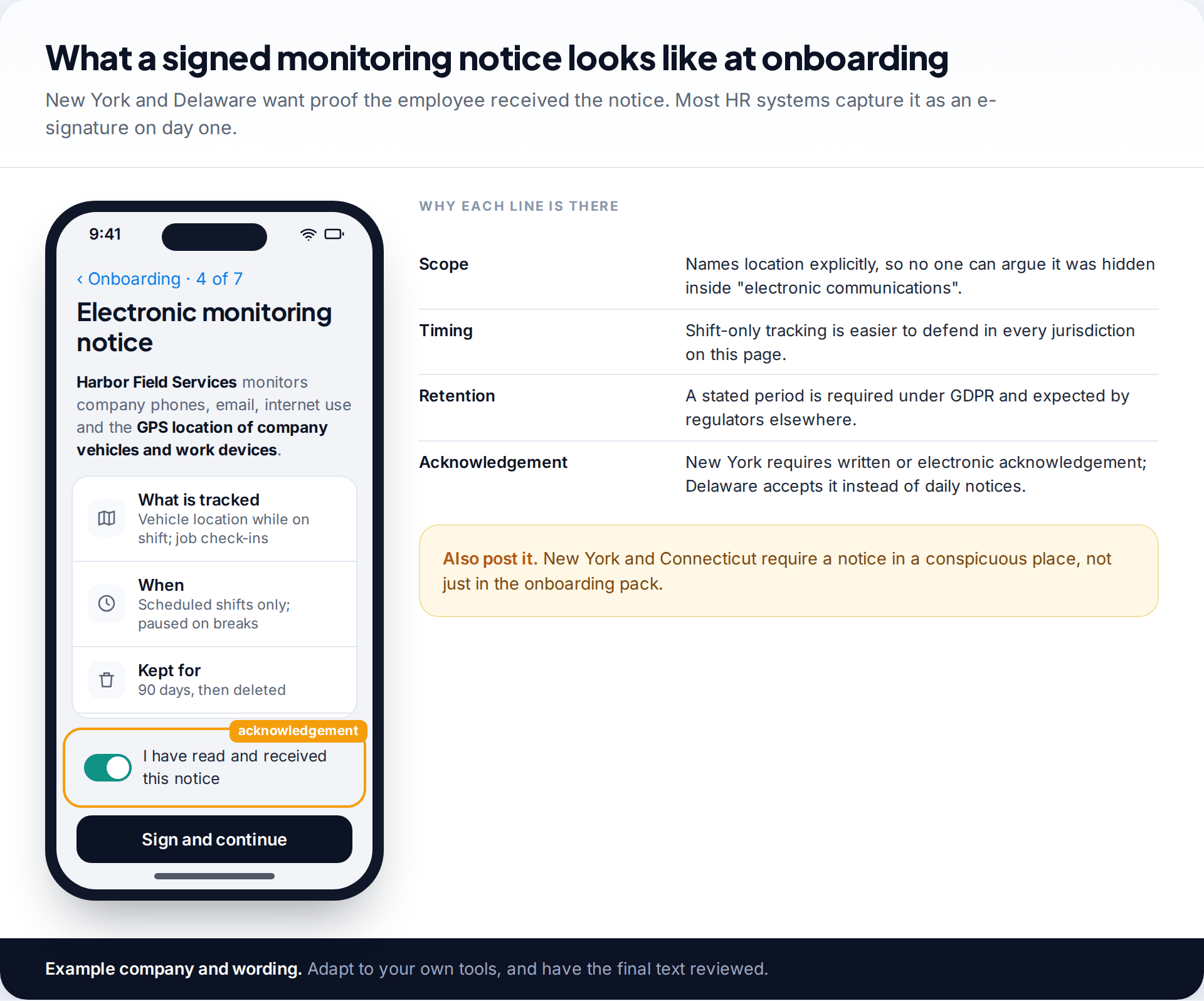
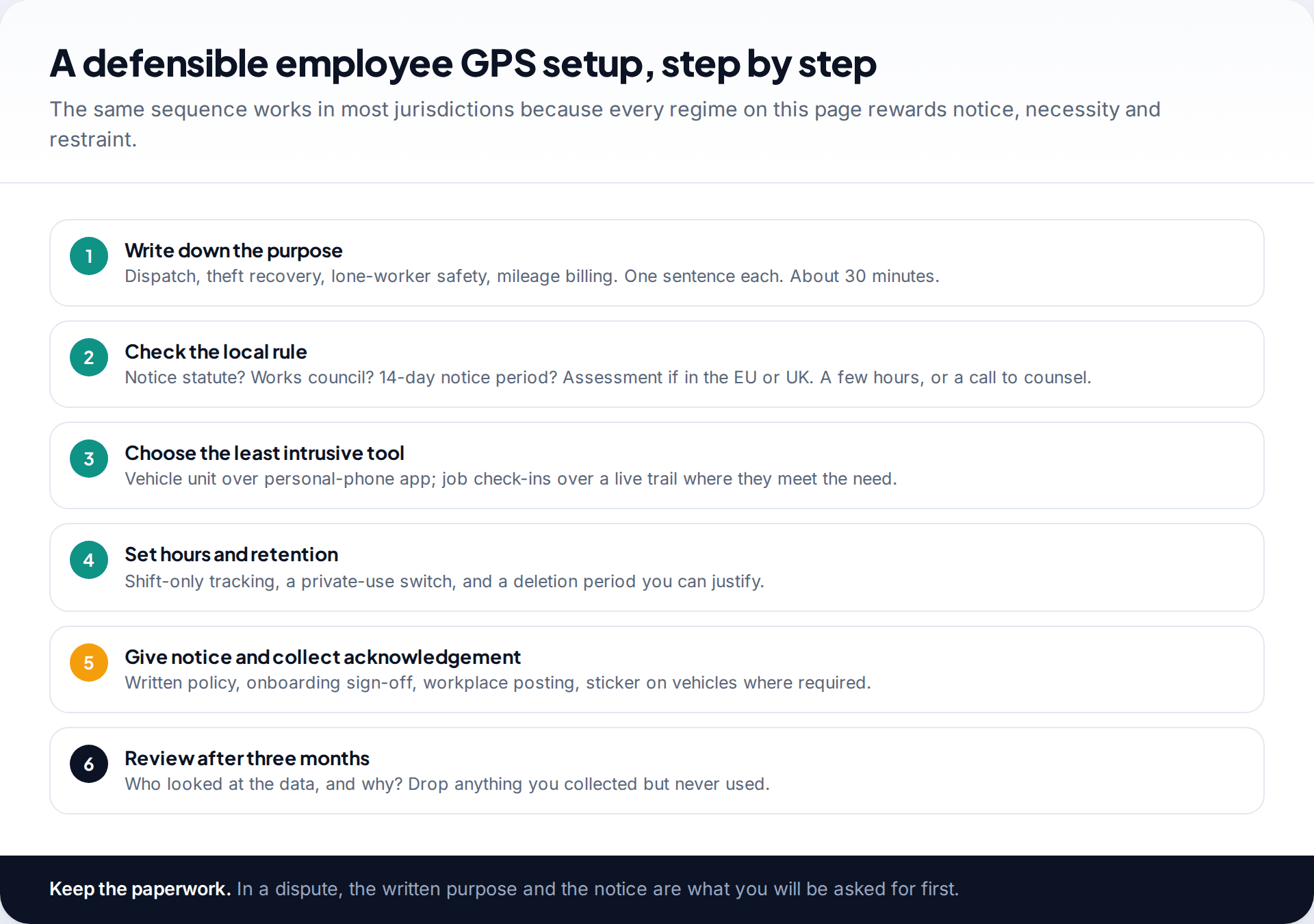
A setup that holds up in most places
If you are planning the practical side too, such as choosing between vehicle units and phone apps, costs, and what the data can do for a small fleet, our starter guide to GPS tracking for small business covers it step by step. Employees who suspect they are being tracked beyond what they agreed to can use our walkthrough on stopping unwanted location tracking to see which settings are in play.
How this page was put together
We read the statutes and official guidance behind each section in September 2026: New York Civil Rights Law §52-c, Connecticut §31-48d and Public Act 26-73, Delaware 19 Del. C. §705, Maine LD 61, California Penal Code 637.7, the California Privacy Protection Agency’s CCPA guidance, the ICO’s monitoring-workers guidance, the CNIL’s vehicle geolocation rules, Ontario’s electronic monitoring policy requirement and the NSW Workplace Surveillance Act 2005. We cross-checked summaries against law-firm briefings where official text was not available.
We are not lawyers and this is not legal advice. We simplified where needed to compare jurisdictions and left out sector rules (such as trucking hours-of-service logs) and public-sector specifics. Read more about our editorial standards and how we correct errors.
Common questions
Can my employer track my personal phone?
Only in narrow circumstances and almost never without your agreement. A tracking app on your own phone generally needs your informed agreement in the US, and in the EU and UK it is hard for an employer to justify at all. Maine now bars employers from requiring such apps.
Do employers have to tell you if they track your company vehicle?
In New York, Connecticut, Delaware, Ontario (for employers with 25 or more staff) and NSW, written notice is a legal requirement. In the EU and UK, transparency is required under data protection law. Elsewhere it may not be required by statute, but tracking without notice exposes the employer to privacy claims.
Can an employer track me after work hours?
This is where most regimes push back hardest. Regulators and courts have criticised tracking over evenings, weekends and holidays, and the CNIL says employees should be able to switch vehicle tracking off outside working time.
Is it legal to track employees without telling them?
Generally no. Covert tracking is treated as exceptional: limited to serious suspected wrongdoing, authorised at a senior level, and in NSW only with a magistrate’s authority. In US notice states it breaches the statute directly.
How long can an employer keep GPS data?
Only as long as the purpose needs. Under GDPR a retention period must be set and justified; the CNIL treats two months as the norm for vehicle data. Elsewhere, a written retention period is still good practice.
Does a works council have to approve GPS tracking?
In Germany, yes in practice: systems capable of monitoring employee behaviour or performance fall under co-determination. Other EU countries have information or consultation duties that vary by country.
The tools behind this guide. TheTruthSpy is a free parental control app for Android: GPS location tracker with geofencing, a screen time app with app limits, a website blocker and web filter, an SMS tracker and call tracker, and social media monitoring for the WhatsApp tracker, Instagram tracker, Snapchat tracker, Facebook Messenger tracker and Viber tracker. See the full parental control feature list, the free parental control pricing, or the download and setup guide.
Related guides
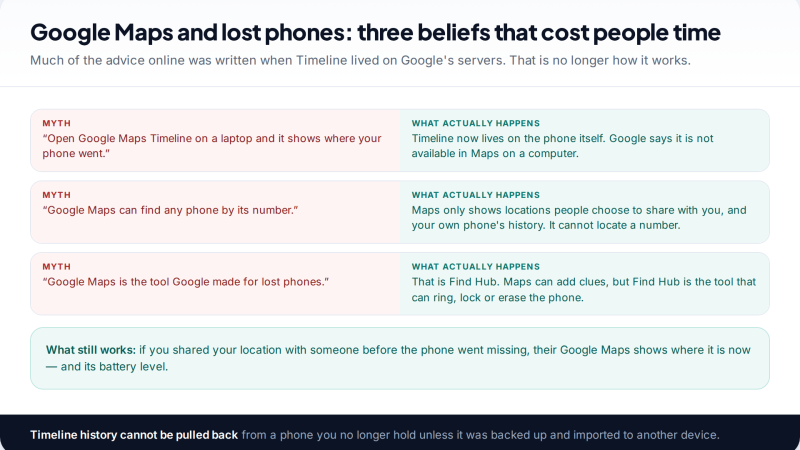
Using Google Maps Timeline to Find a Lost Phone
Can Google Maps find a lost phone? Only in two cases: someone you share your location with can see it,…
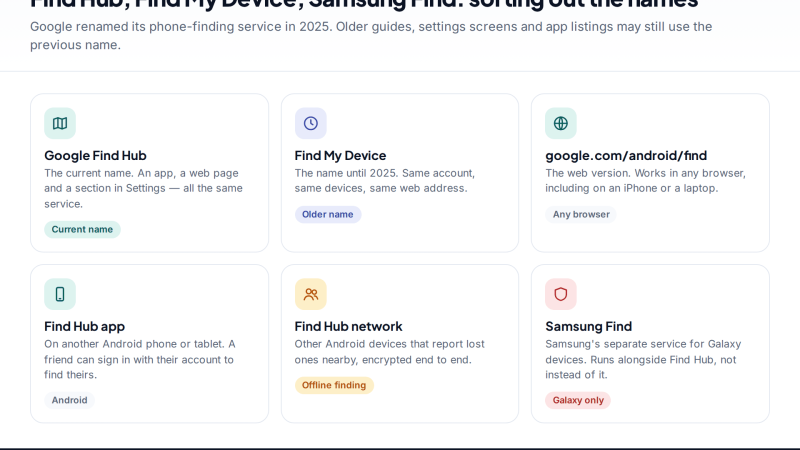
Google Find Hub (Find My Device): A Complete Walkthrough
A full walkthrough of Google Find Hub, the service formerly called Find My Device on Android: the settings to check…
Real-Time Location for Your Child’s Phone: Setting It Up Properly
How to track your child's phone location in real time, openly: Family Link for Android, Family Sharing and Find My…
Free parental control app for Android
GPS tracking, screen time limits, web filtering, SMS and call monitoring — visible on your child's phone. Pair a phone in about ten minutes.
Android · Free to set up · Visible on your child's phone