Where Is a Phone Number From? Legal Ways to Find Its General Location

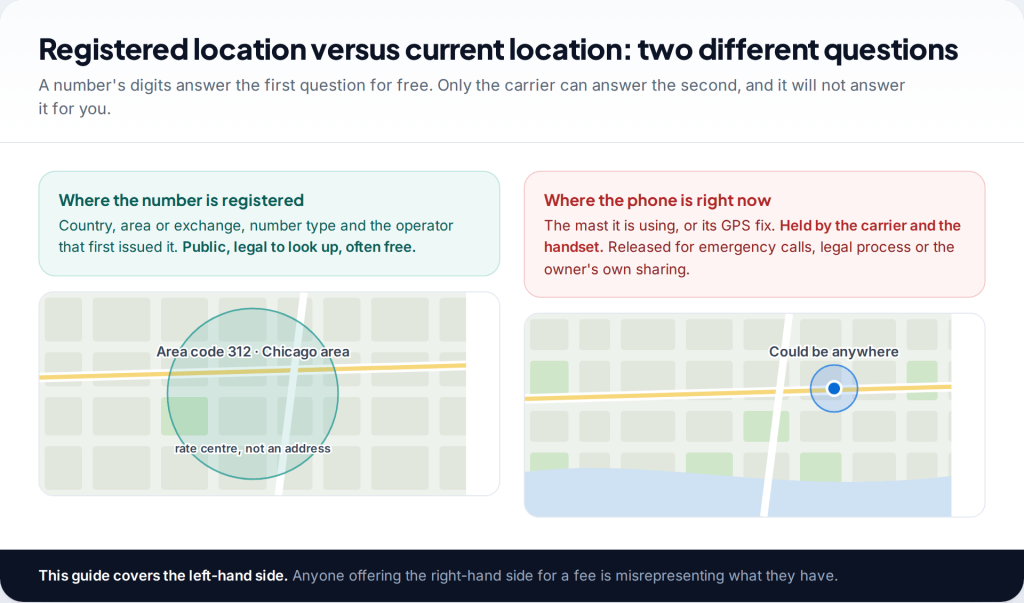
A missed call from a number you don’t recognise usually raises one question: where is it from? You can find a phone number’s location legally in the sense that matters here — where it is registered — by reading its country code, area code and number type, and checking which carrier issued it. You cannot legally find where the phone is right now; only the carrier holds that, and it releases it only on strict terms.
Phone number location, legally: two questions that sound the same
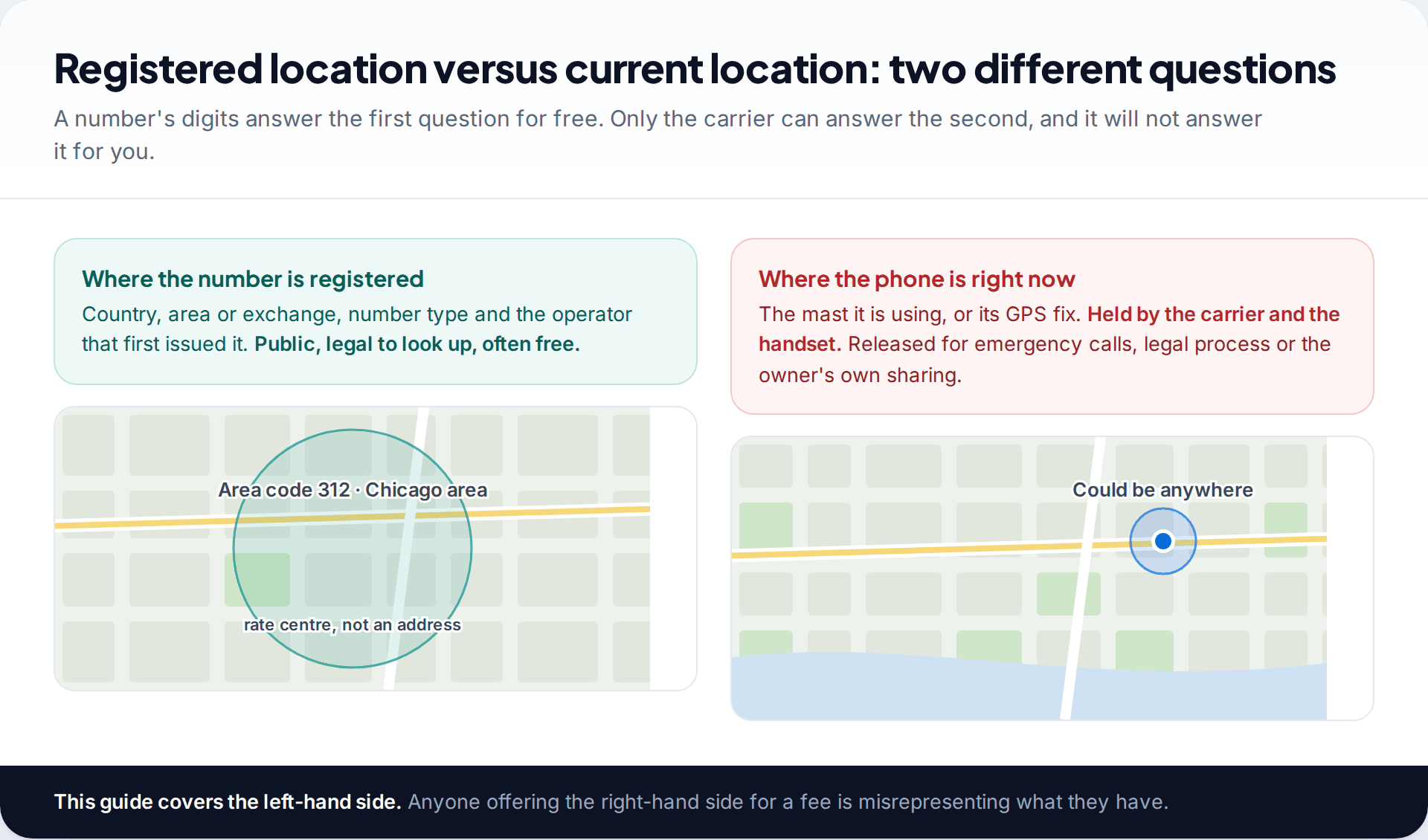
“Where is this number from?” and “Where is this phone?” get treated as one question, and that confusion is what number-tracker sites exploit. The first is answered by public numbering plans, which regulators publish so that calls can be routed and billed. The second is known to the mobile network and the handset, and is protected by telecoms and privacy law.
Everything on this page is about the first question. It is free or cheap to answer, entirely legal, and often enough: it tells you whether a call came from abroad, from a landline in a particular area, from a mobile, or from a freephone or premium line. If what you really need is someone’s current position, see what is and isn’t possible when tracking from a number alone.
Step 1: Read the country code
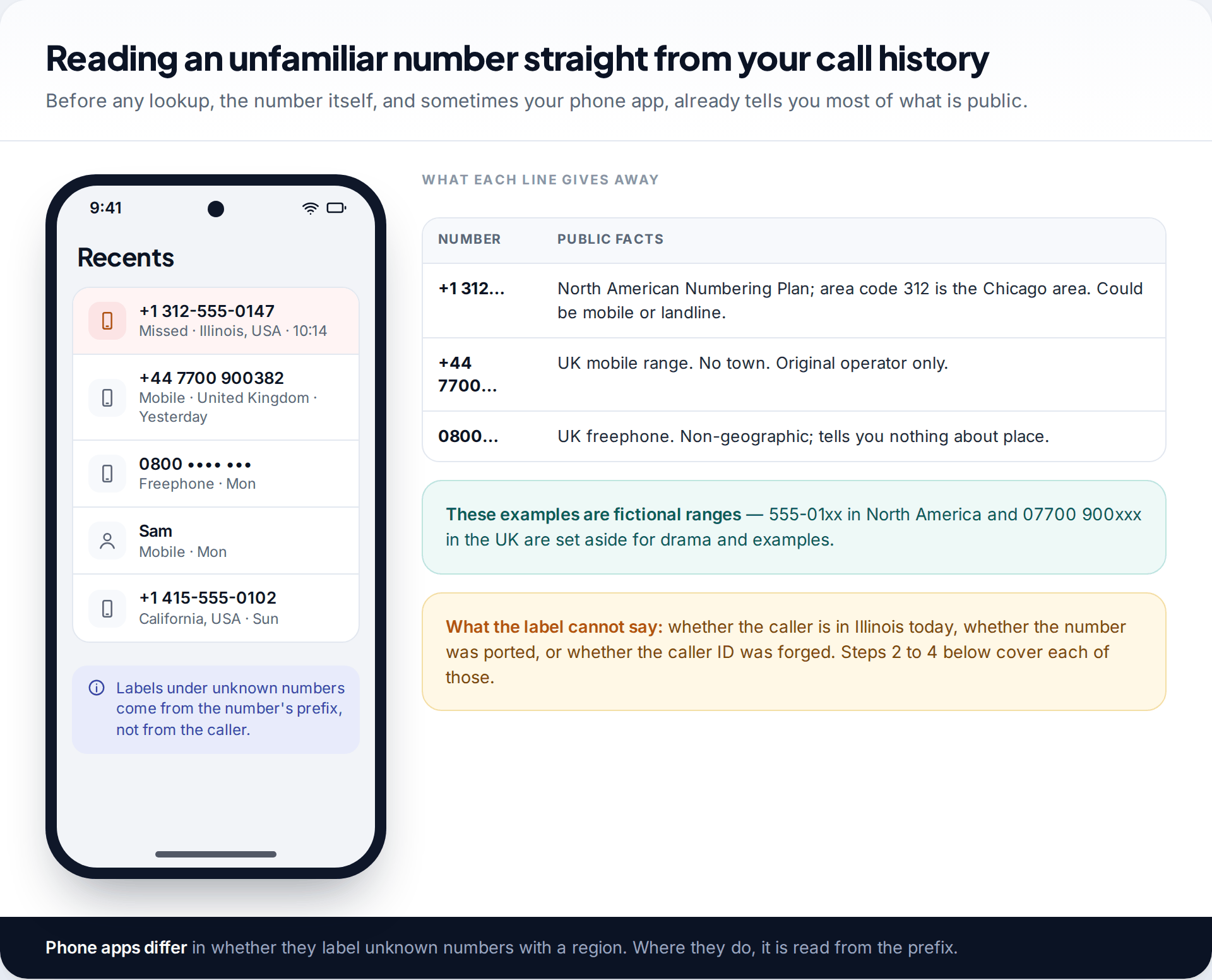
International numbers start with a country code of one to three digits, allocated under the ITU’s E.164 standard, which caps a full international number at 15 digits. +44 is the UK, +33 France, +61 Australia. +1 is shared by the twenty countries of the North American Numbering Plan, including the US, Canada and many Caribbean nations, so a +1 number alone doesn’t even tell you which country.
A foreign country code on a call you weren’t expecting is worth pausing over. Mobile phones roam, so it doesn’t prove the caller is abroad, but unexpected international calls are a common vehicle for scams, including ones designed to make you call back an expensive number.
Step 2: Read the area code, if there is one
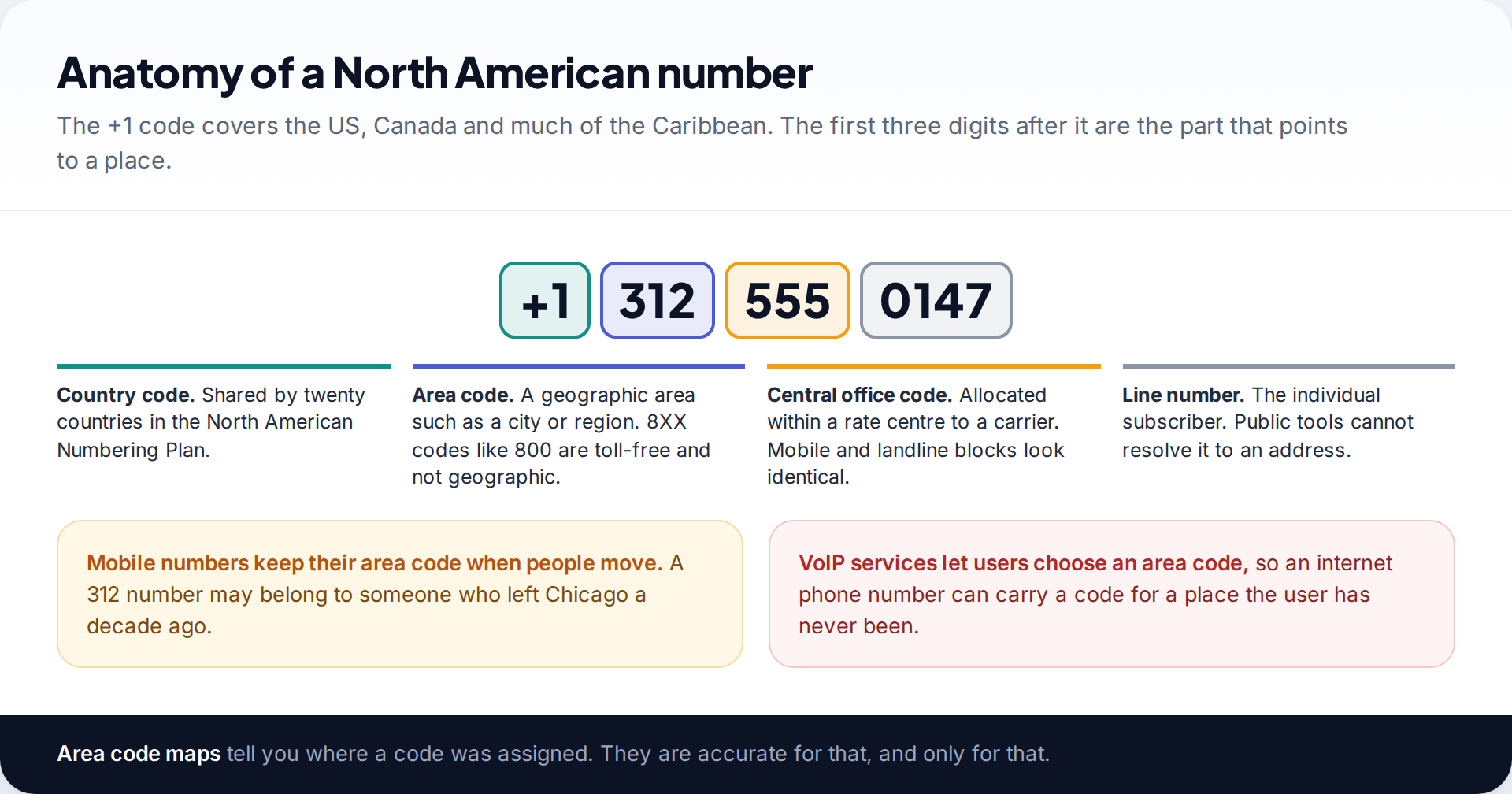
In North America every ordinary number has a three-digit area code, and area codes are geographic: 312 is the Chicago area, 415 San Francisco, 416 Toronto. The next three digits belong to a block allocated to a carrier within a “rate centre”, the area used for local calling and billing. Mobile and landline numbers come from the same plan and look identical, so you can’t tell them apart by eye.
Two things weaken the area code as evidence. Mobile numbers go with their owners: people keep their original number for years after moving. And internet (VoIP) numbers can be issued with almost any area code the user picks. An area code tells you where a number was assigned, which is useful, but it is not where the caller lives.
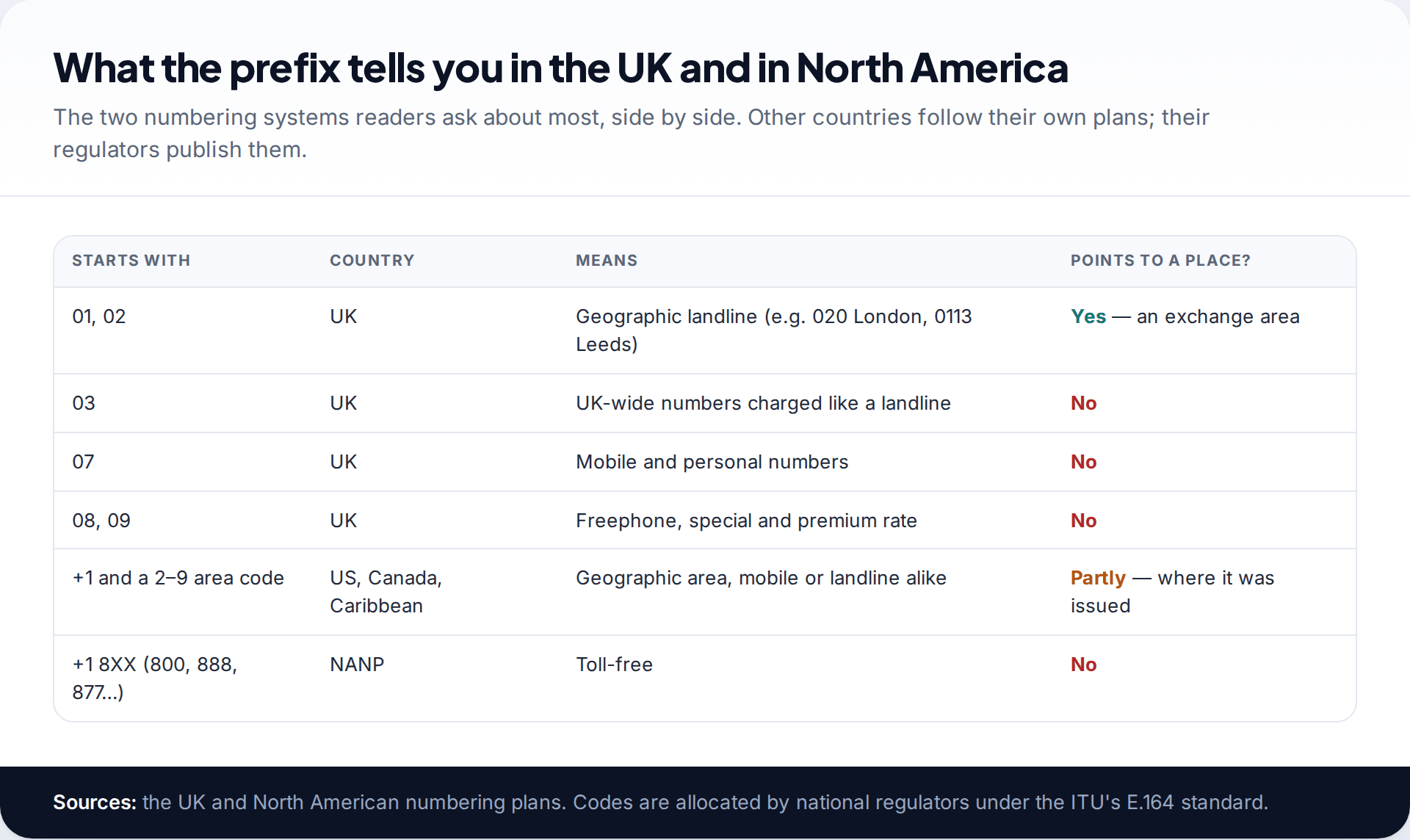
The UK works differently. Geographic landlines start 01 or 02 — 020 for London, 0113 for Leeds, 0161 for Manchester. Mobiles have their own range starting 07, which carries no place at all. 03 numbers are UK-wide and priced like landlines; 08 and 09 are freephone, special and premium rate. So a UK mobile number tells you it is British and, at most, which operator first issued it.
Step 3: Work out the number type
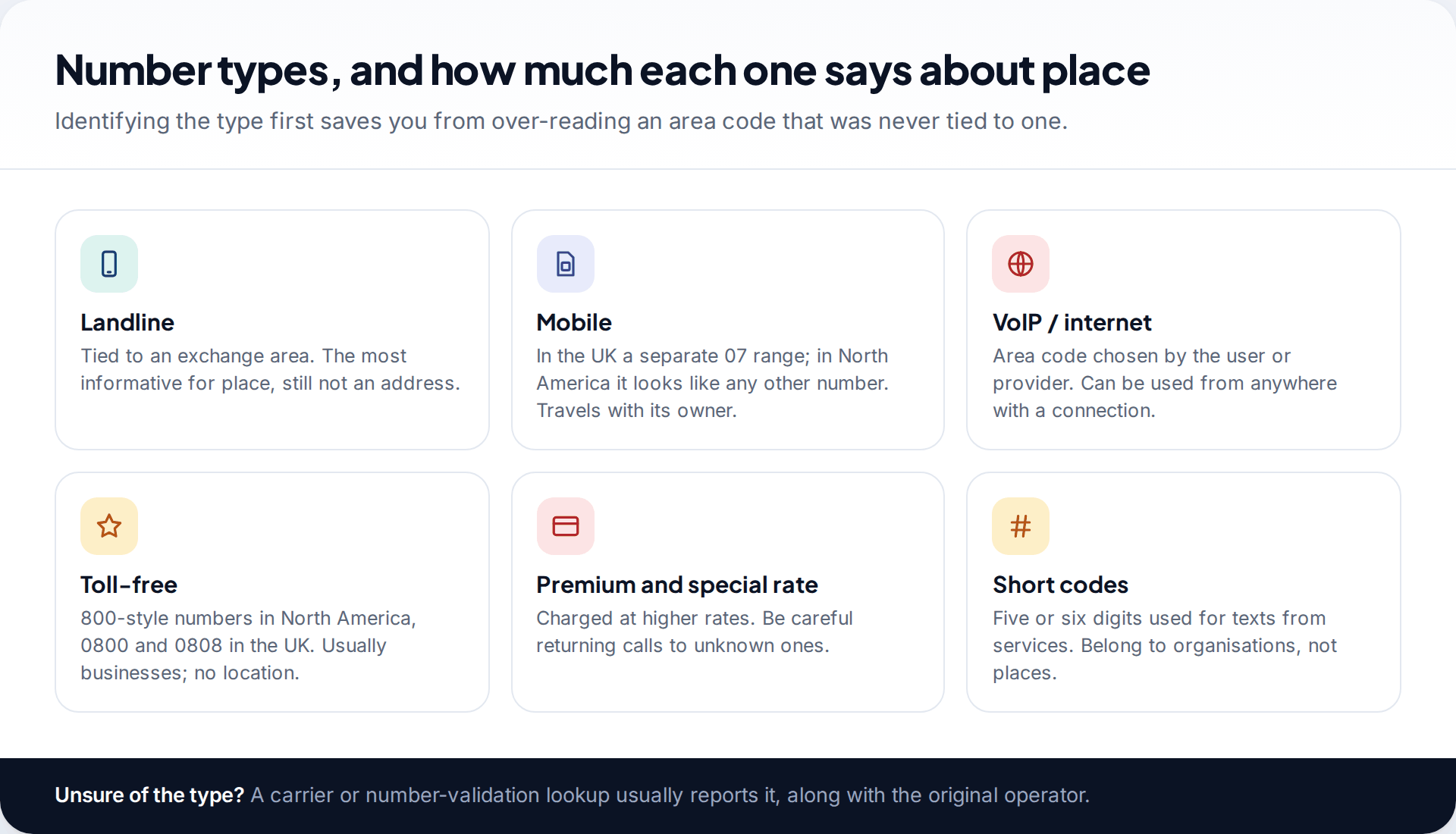
Knowing the type stops you over-reading the digits. A landline is the most informative, tied to an exchange area. A mobile only indicates where it was issued. A VoIP number may reflect nothing but a choice the user made on a website. Toll-free and special-rate numbers belong to services and say nothing about place, and short codes used for texts belong to organisations.
If the prefix doesn’t make the type obvious, a number-validation or carrier lookup service will usually report it. Many offer a few free checks. They report the line type and the operator, which is exactly what they are entitled to know.
Step 4: Check the carrier, and allow for porting
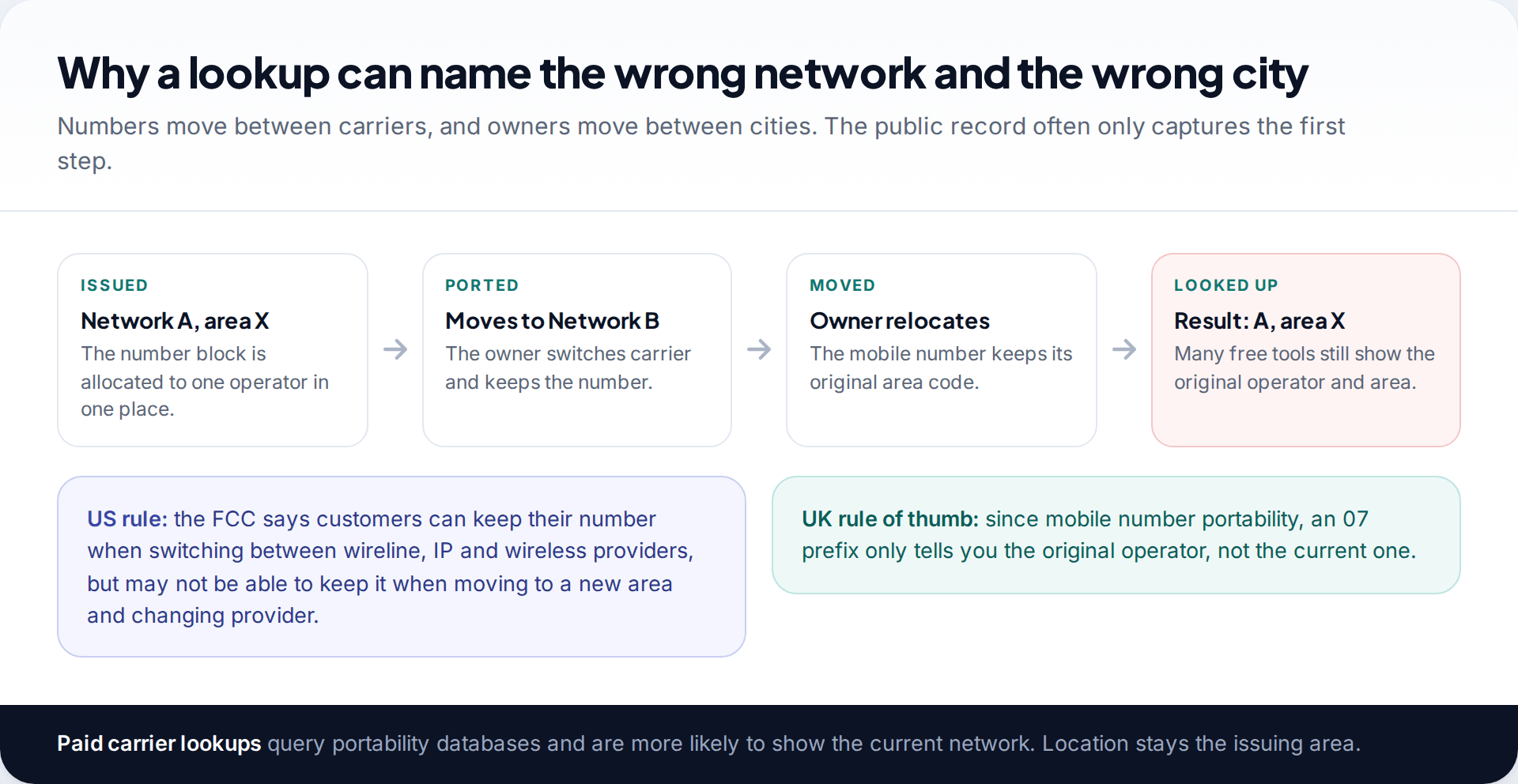
Knowing the carrier helps with some practical questions — whether a number is a mobile, whether a text came from a genuine operator, whether it is a known VoIP provider. The catch is number portability. The US Federal Communications Commission says customers can keep their number when switching between wireline, IP and wireless providers, though not always when also moving to a new area. In the UK, the prefix of a mobile number now only tells you the operator that first issued it.
Free tools often read the prefix and report that original operator. Paid carrier lookups that query portability records are more likely to show the current network. Neither changes the location, which stays the area where the number was first issued.
Reverse phone lookup: what is legal, and what it can find
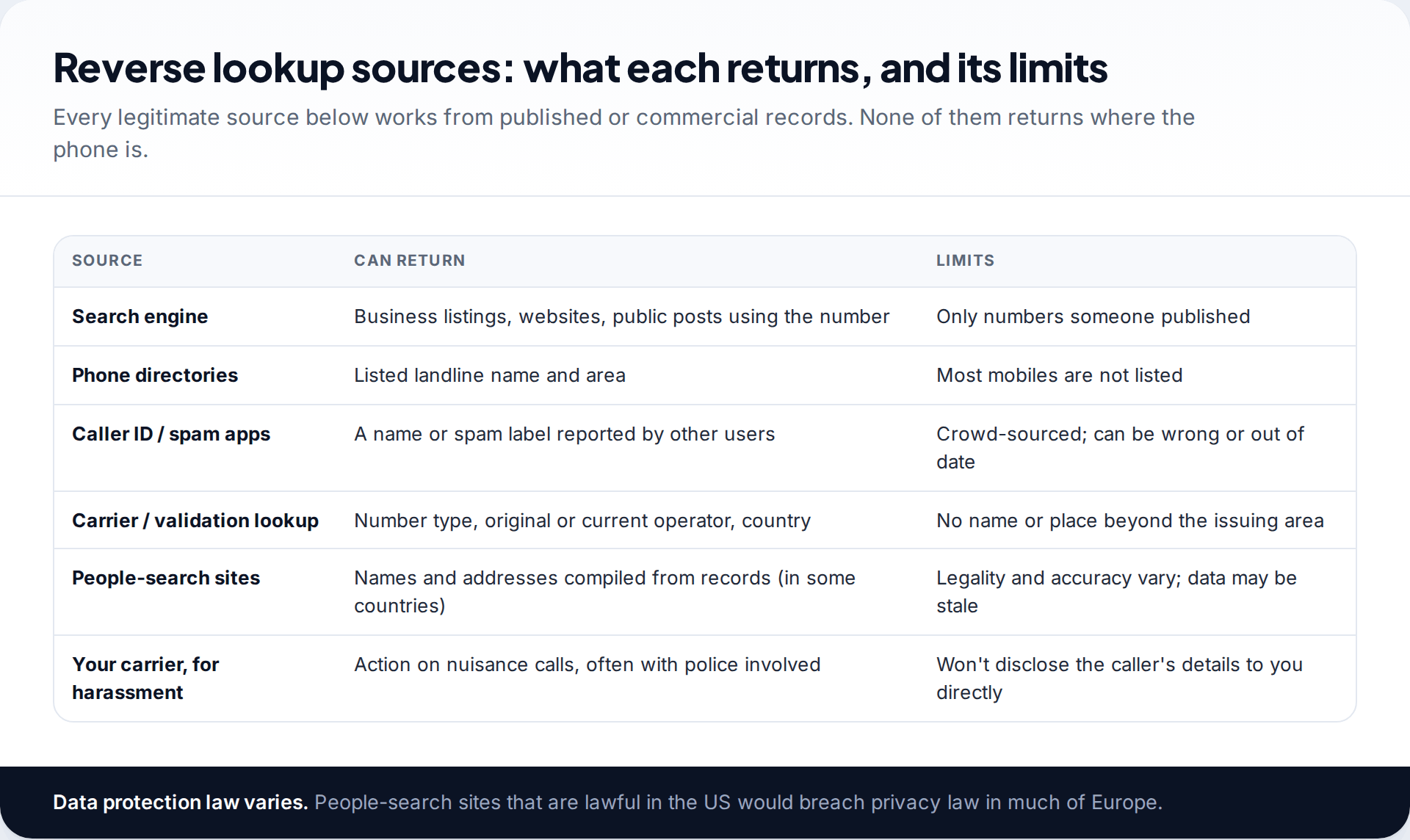
Reverse lookup means going from a number to an owner. The lawful routes are narrower than adverts suggest. A search engine finds numbers that someone published, usually businesses. Phone directories list some landlines. Caller ID and spam-blocking apps show names or labels contributed by other users, which are helpful for spotting nuisance callers but can be wrong. People-search sites compile names and addresses from records; that is legal in the US and some other countries, but the same activity would conflict with data protection law across much of Europe, and quality varies widely.
If the calls amount to harassment, don’t try to identify the caller yourself. Keep a log, report it to your carrier, and involve the police. They can obtain subscriber details through legal process; your carrier won’t hand them to you directly.
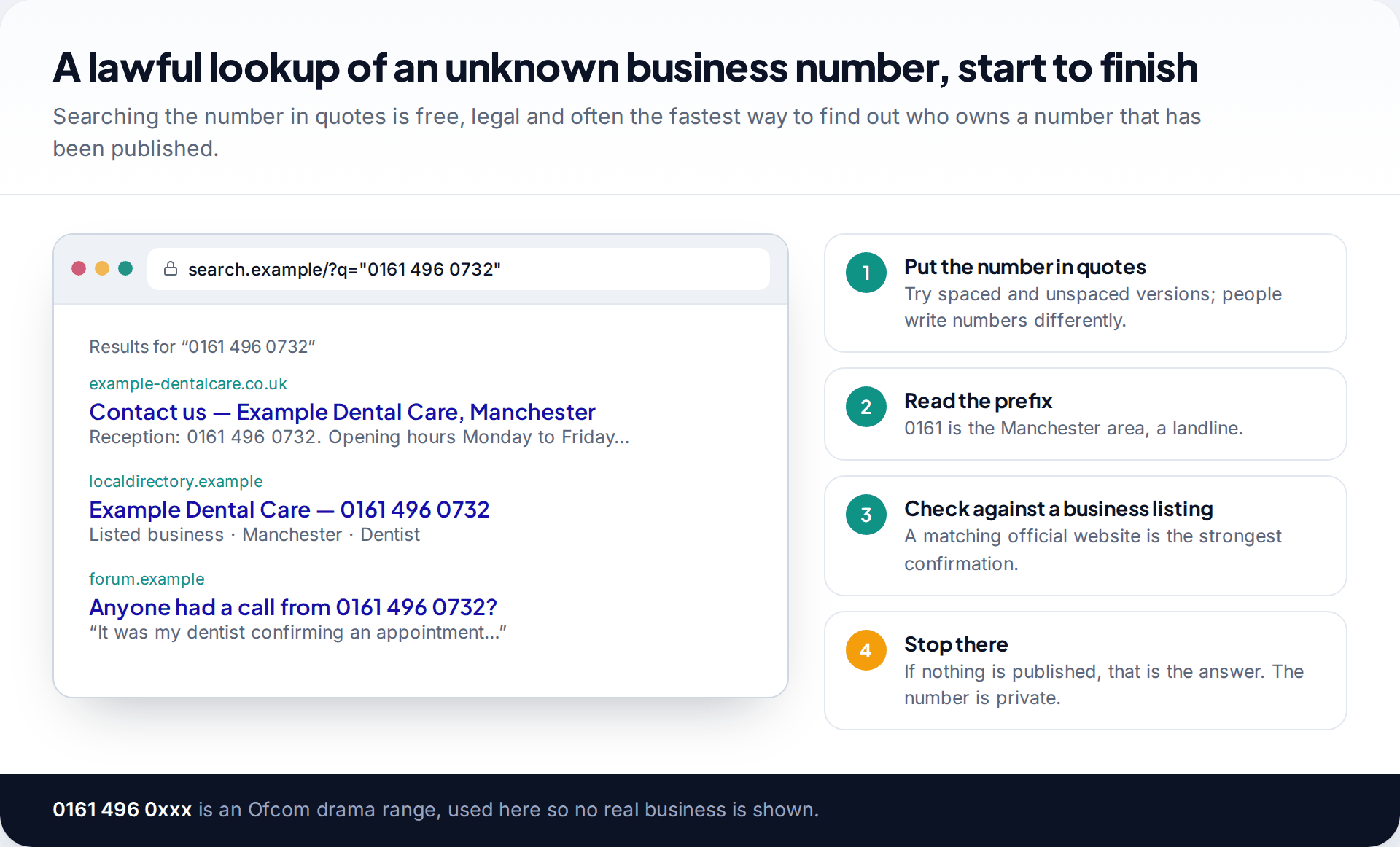
A missed call from 0161 496 0732
The 0161 prefix places it as a Manchester landline, so it isn’t a mobile and is likely a business or household. Searching the number in quotes turns up a dental practice’s contact page and a matching directory listing. The caller’s identity is confirmed from the business’s own website, not from a lookup site, and no personal data was needed.
When the number itself is a lie
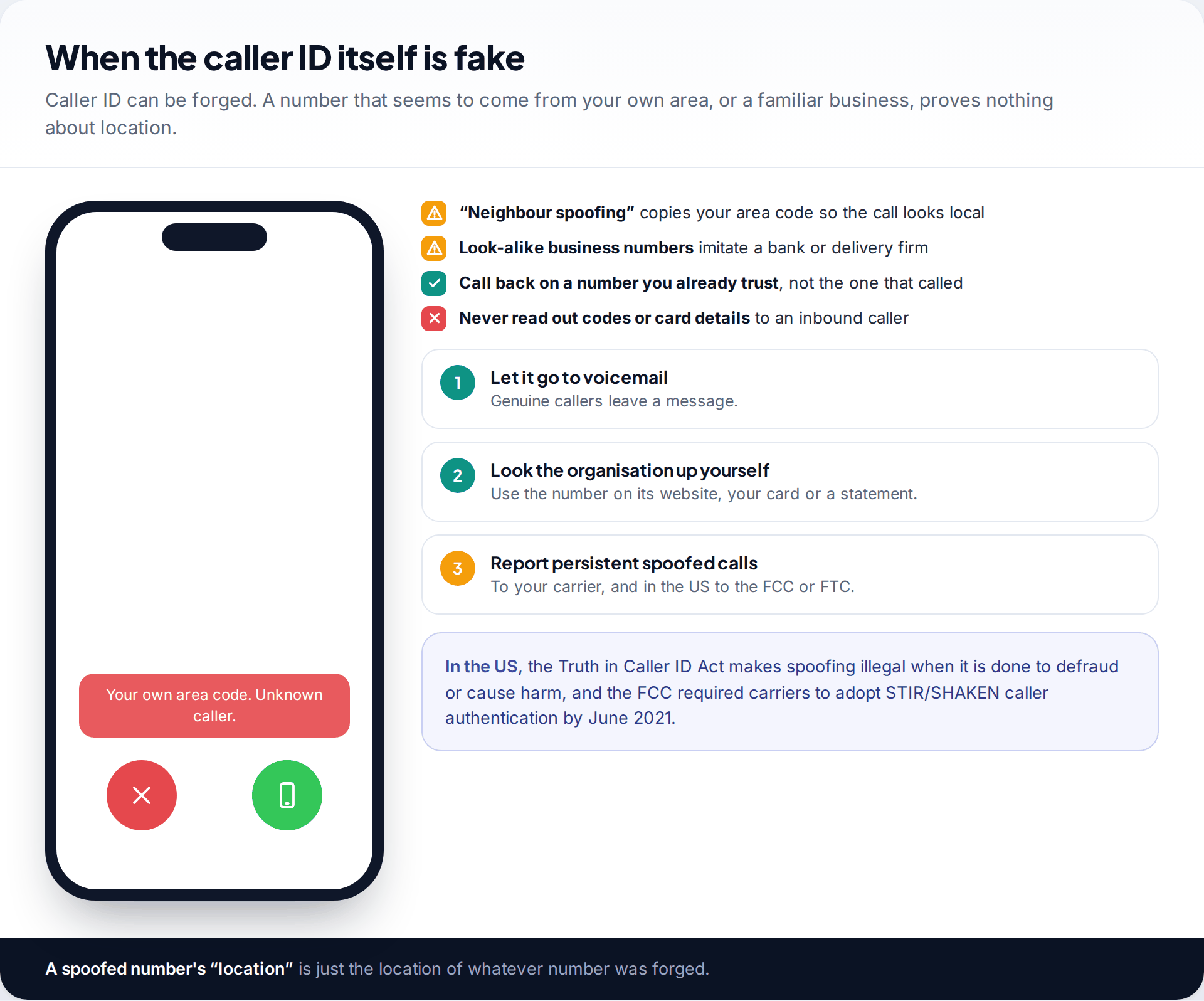
Everything above assumes the number shown is the real one. Caller ID can be spoofed. A common tactic, known as neighbour spoofing, displays a number that shares your own area code so the call feels local. Others imitate a bank’s or a courier’s number. In the US, the Truth in Caller ID Act makes spoofing illegal when it is done to defraud or cause harm, and the FCC required carriers to adopt STIR/SHAKEN caller authentication on their IP networks by 30 June 2021, but spoofed calls still get through.
So treat a number’s area as a hint, never as proof. If a caller claims to be from an organisation, hang up and call back on a number you already trust.
Unexpected calls from abroad: what the origin can warn you about
The most practical use of a number’s origin is deciding whether to call back. A pattern known as the one-ring or “wangiri” scam places a brief call from an international or premium-rate number and hangs up, hoping you will return it and run up charges that are shared with the scammer. The country code is your first defence: if you don’t know anyone there, don’t call back. Genuine callers leave messages or send texts.
The same logic applies to texts. A message claiming to be from your bank, a delivery company or a tax authority, sent from an ordinary mobile number or an overseas one, doesn’t match how those organisations usually contact people. Short codes and registered sender names are more typical, though those can be imitated too.
Your phone can do some of this sorting for you:
- On iPhone, the Phone settings include Silence Unknown Callers, which sends calls from numbers not in your contacts, recent outgoing calls or Siri suggestions straight to voicemail. Settings layout has changed in recent iOS versions, so search Settings for “silence” if it isn’t where you expect.
- On Android, the Google Phone app’s settings include Caller ID & spam, which labels suspected spam and can filter it. Samsung and other manufacturers have their own equivalents, with different names.
- Carriers offer their own call-screening and spam-labelling tools, some free, some paid. Look in your carrier’s app.
None of these tools locate anyone. They use the number’s origin, its reputation among other users and caller authentication signals to decide how much to trust the call, which is the same reasoning this guide walks through by hand.
What you cannot find legally
- The phone’s current location. Held by the carrier; released for emergency calls, under legal process, or through the owner’s own sharing.
- The subscriber’s name from the carrier. Carriers don’t disclose customer details to other members of the public.
- An address from a mobile number, unless the owner published one alongside it.
- Location history. Only the carrier, the handset and apps the owner allowed hold it.
If you want to see a number’s area on a map, you can do that with ordinary tools; our guide to what Google Maps can show for a phone number explains the limits.
How this page was put together
We checked the numbering facts in September 2026 against the UK and North American numbering plans, the ITU’s E.164 framework, the FCC’s consumer guide to number porting and published summaries of the Truth in Caller ID Act and STIR/SHAKEN rules. All example numbers use ranges regulators reserve for fiction, so none belongs to a real person or business.
We didn’t test or rank lookup services. Rules on people-search sites and personal data differ by country, so check your local law before relying on one. Our standards for sourcing and corrections explain how we keep guides current.
Common questions
Is it legal to look up where a phone number is from?
Yes. Country codes, area codes and number ranges are published so calls can be routed. Reading them, or using a lookup that reports the type and carrier, is lawful.
Can I find a phone number’s exact address?
Only if the owner published it, for example on a business website. Numbering plans go no further than an area, and carriers don’t disclose customer addresses to the public.
Why does a lookup show a city the caller has never lived in?
Mobile numbers keep their original area code when people move, and VoIP numbers can be issued with any area code. The lookup is showing where the number was assigned.
Can I tell if a number is a mobile or a landline?
In the UK, yes: 07 is mobile, 01 and 02 are landlines. In North America the two look the same; a carrier or validation lookup will tell you.
Is a free reverse phone lookup accurate?
For number type and original carrier, usually. For names, less so; crowd-sourced and compiled data can be out of date. None of them show where the phone is now.
What should I do about repeated calls from an unknown number?
Block it, report it to your carrier, and keep a record of dates and times. If it amounts to harassment, report it to the police, who can obtain the subscriber’s details through legal process.
Looking for a tool to go with this? TheTruthSpy is a free parental control app for Android that stays visible on the child's phone. If it fits your family, see the Location & geofencing feature.
Related guides
How Accurate Is Phone Location Tracking? GPS, Wi-Fi and Cell Compared
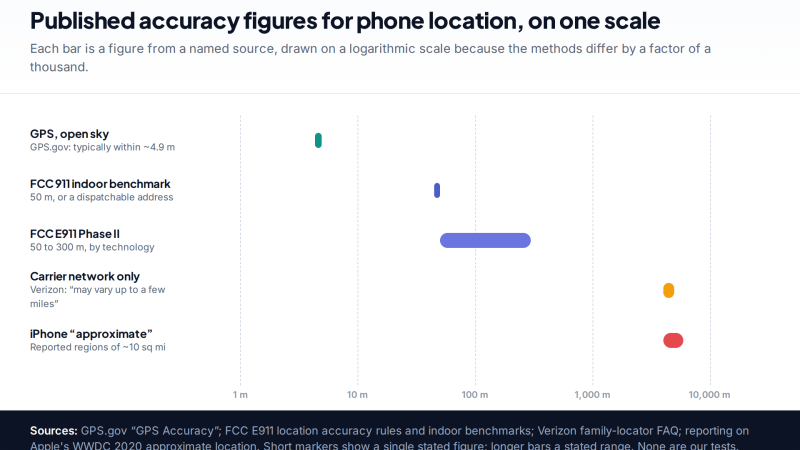
Phone location accuracy runs from a few metres with GPS under open sky to miles when only the mobile network…
Using Google Maps Timeline to Find a Lost Phone
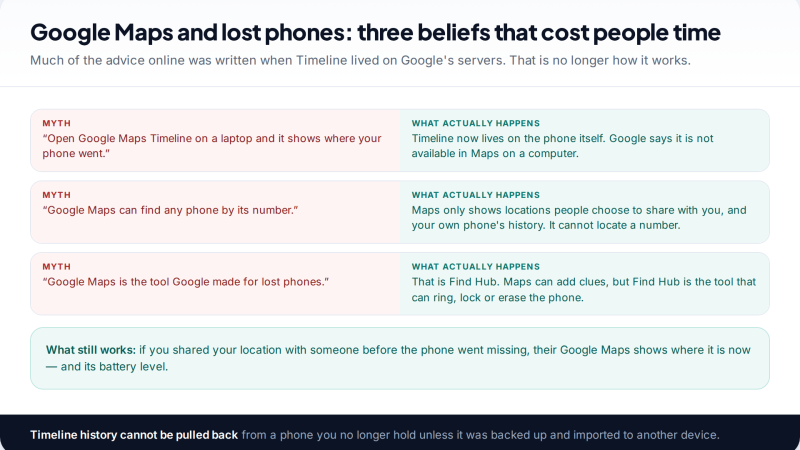
Can Google Maps find a lost phone? Only in two cases: someone you share your location with can see it,…
GPS Tracking for Small Business: A Starter Guide
A plain starter guide to GPS tracking for a small business: vehicle trackers versus phone apps, what a small fleet…
Parental controls your child can see
Location, screen time limits, a web filter and alerts from notifications — free, and visible on your child's phone. Pair a phone in about ten minutes.
Android · Free to set up · Visible on your child's phone