Tracking a Phone From Its Number Alone: What Is True and What Is a Scam

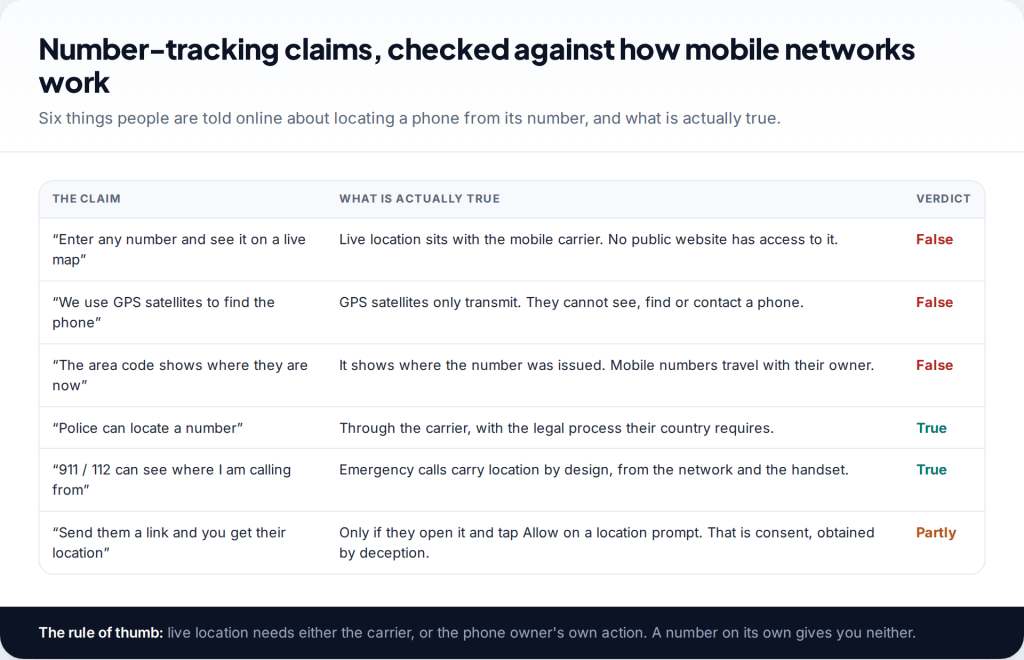
No, you cannot track a phone with just the number. A mobile number is an address the network uses to route calls, and the only organisation that knows where that phone is right now is its carrier. Carriers pass location to emergency services automatically, to police under legal process, and to their own customers through opt-in services. Websites promising a live map from a number have access to none of that.
- The carrier knows, and keeps it. The network tracks which mast a phone is using so calls can reach it. That data is not published anywhere a website can query.
- Emergency services and police are the exceptions. Emergency calls carry location by design; police go through the carrier with a warrant or equivalent order.
- A number reveals its origin, not its position. Country, original carrier and, for landlines, an exchange area.
- “Tracker” sites sell subscriptions and collect data. Their only real location trick is a link the other person has to open and approve.
Can you track a phone with just the number? The claims, checked
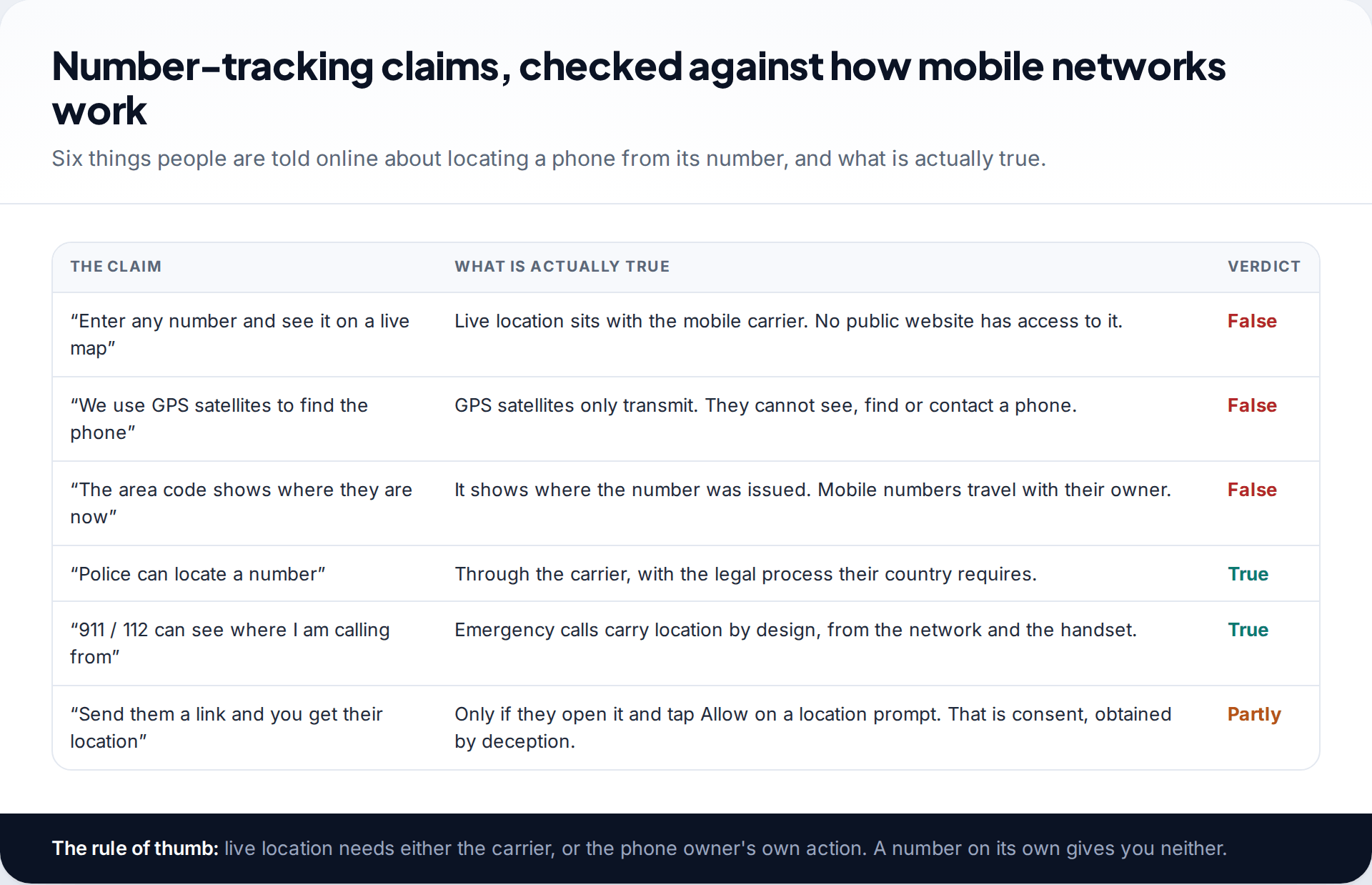
Search for a way to locate a number and you will find confident promises: enter the digits, press a button, see a pin on a map. The mechanics behind mobile phones make that impossible for an outsider. A phone does not broadcast its position to the internet. It reports to the nearest masts of its own network, and, when it has a GPS fix, it keeps that position on the handset unless an app the owner installed is allowed to share it.
GPS is the most misunderstood part. The satellites send out timing signals and nothing else. A phone listens to them and works out its own position; the satellites have no idea the phone exists. So a site that says it “pings the phone via satellite” is describing something that cannot happen.
Two claims on the list are true, and both involve institutions rather than websites. Understanding who those are explains why the rest of the internet is locked out.
Who really can locate a phone number
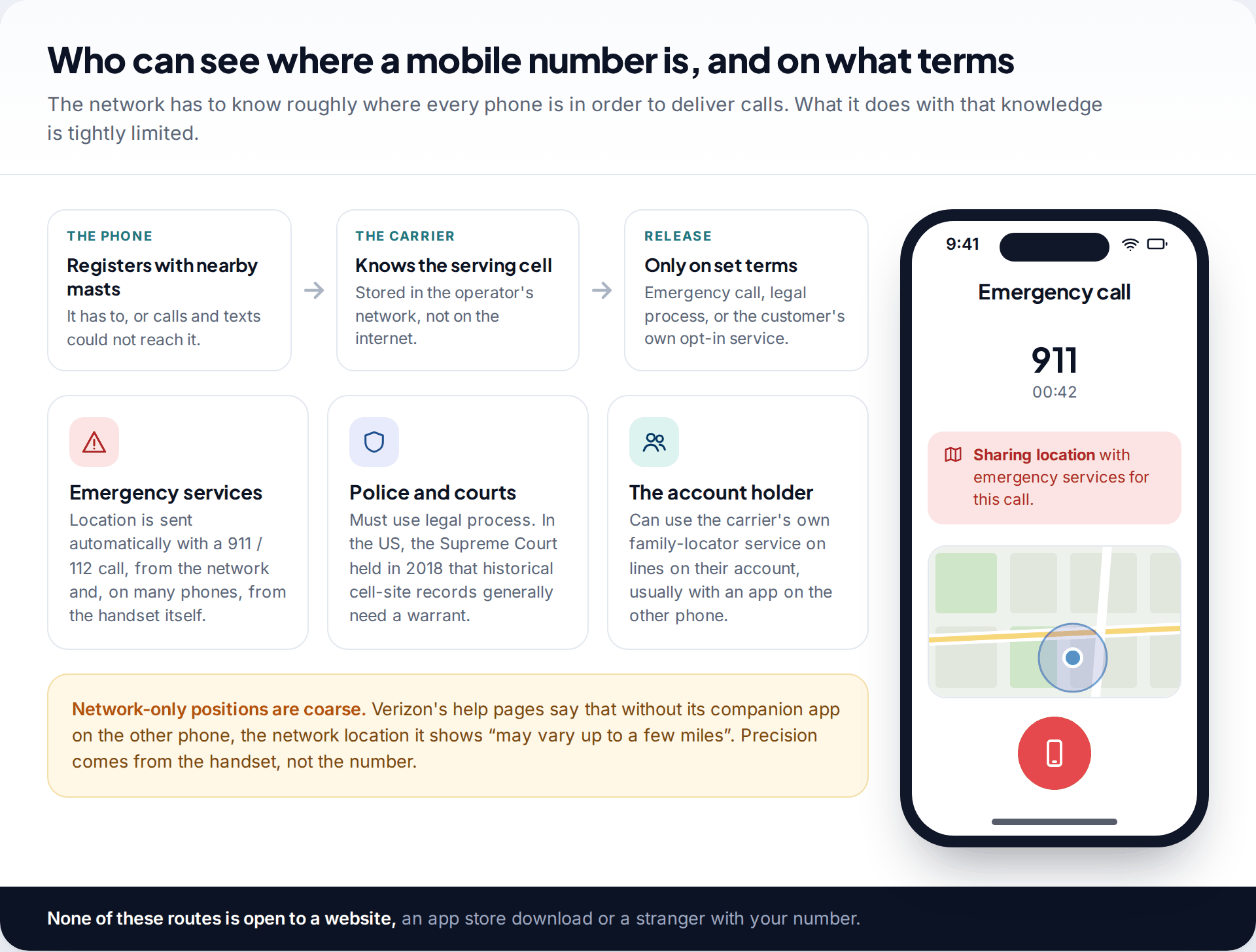
The mobile carrier. To deliver a call, the network has to know which cell your phone is registered on. That gives the operator a rough position at all times, and a sharper one when it combines several masts. This is stored in the operator’s systems and governed by telecoms privacy law.
Emergency services. When you dial 911, 112 or 999, your location travels with the call. In the US, the Federal Communications Commission’s E911 rules require carriers to pass on the caller’s coordinates. Many phones add their own handset-based position on top: Android’s Emergency Location Service, for instance, sends GPS, Wi-Fi and cell data to an endpoint run by emergency partners in supported countries, and Google says it does not see that location. Call-takers can often locate you more precisely than any consumer app.
Police, through legal process. Officers cannot type a number into a public tool. They ask the carrier, using whatever order their jurisdiction requires. In the United States the Supreme Court ruled in Carpenter v. United States (2018) that obtaining historical cell-site location records is a search that generally needs a warrant. Genuine emergencies, such as a missing person at risk, have faster routes, but they still run through the carrier and the police.
The account holder, with the other person’s phone involved. Some carriers sell family locator services for lines on the same account. Verizon’s own help pages, for example, say that without its companion app on the child’s phone the parent sees only an approximate network location that “may vary up to a few miles”. Precise location needs the app installed on the phone being located.
What the number itself gives away
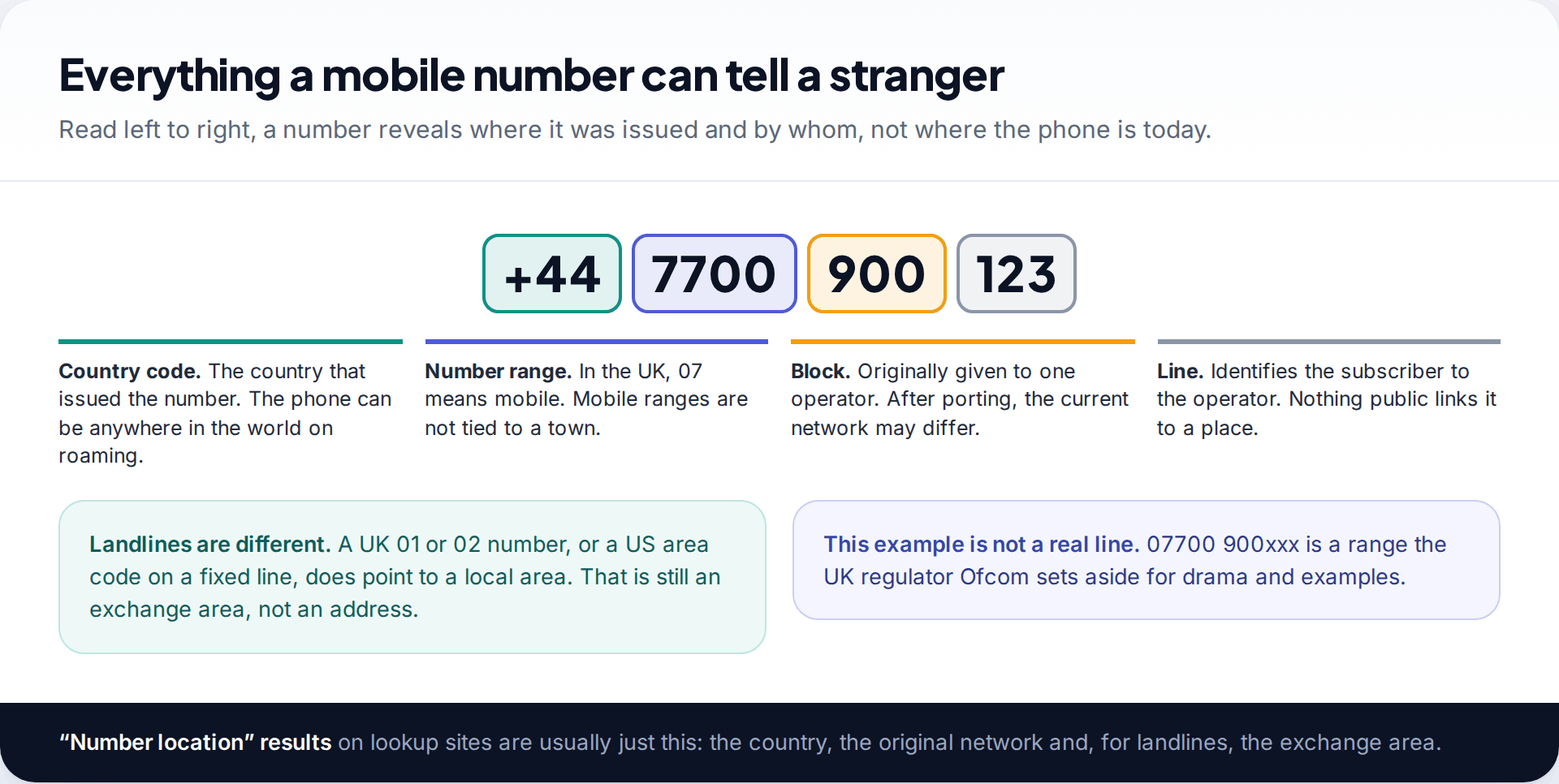
Take any number apart and you get a short list of facts. The country code shows which country issued it. In the UK, a number starting 07 is a mobile or personal number; 01 and 02 are landlines tied to an area. In North America, area codes are geographic for both landlines and mobiles, but mobile numbers keep their area code when their owner moves, so a 212 number may belong to someone who left New York years ago.
The block of digits after that was originally allocated to one operator. Because numbers can be ported between networks, that tells you who first issued it, not who carries it today. This is what most free “number location” results actually show: country, original network and, for a landline, the exchange area. If that is all you need, you can usually work it out yourself from the digits, for free, without visiting a lookup site at all.
How phone number tracker sites really work
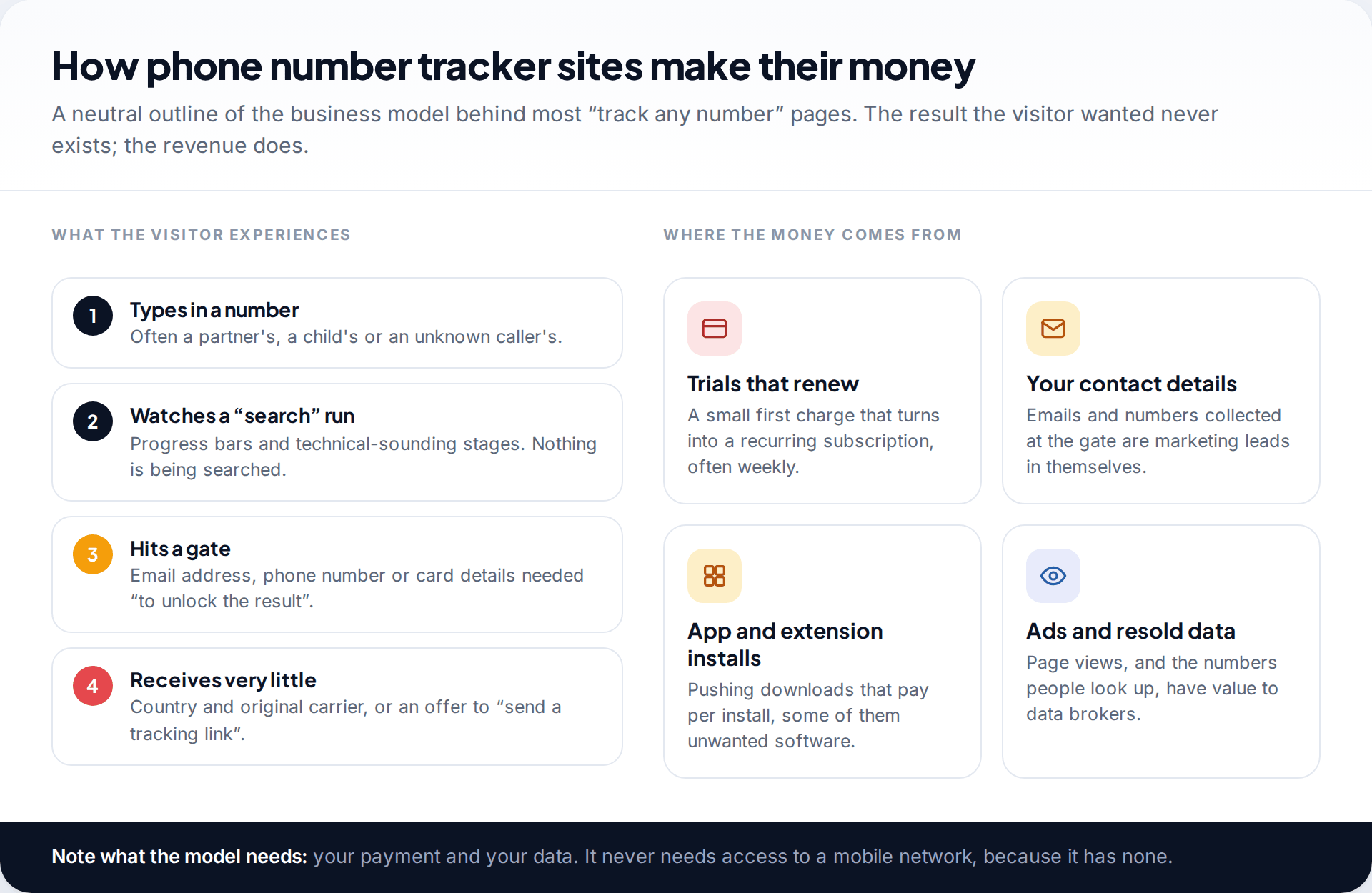
Most “track any number” pages follow the same script. You type in the number. The page runs a slow, dramatic “search” with progress bars and technical-sounding steps, which builds commitment and implies something real is happening. Then comes a gate: enter your email, verify your own phone number, or pay a small amount to “unlock the full report”.
What arrives after the gate is usually the public information described above, dressed up with a map of the area code, or an offer to send the other person a link. The revenue comes from elsewhere:
- Recurring charges. A low first payment quietly becomes a weekly or monthly subscription, disclosed in small print.
- Lead collection. The email addresses and phone numbers entered at the gate are sold or reused for marketing.
- Install bounties. Some pages push app or browser-extension downloads that pay the site per install.
- Advertising and data. Heavy ad placement, and a record of which numbers people look up, which is itself useful to data brokers.
None of this requires access to a mobile network, which is the giveaway. A service that really could locate any phone would be doing something carriers are fined for.
The link trick: the only way these sites get a location
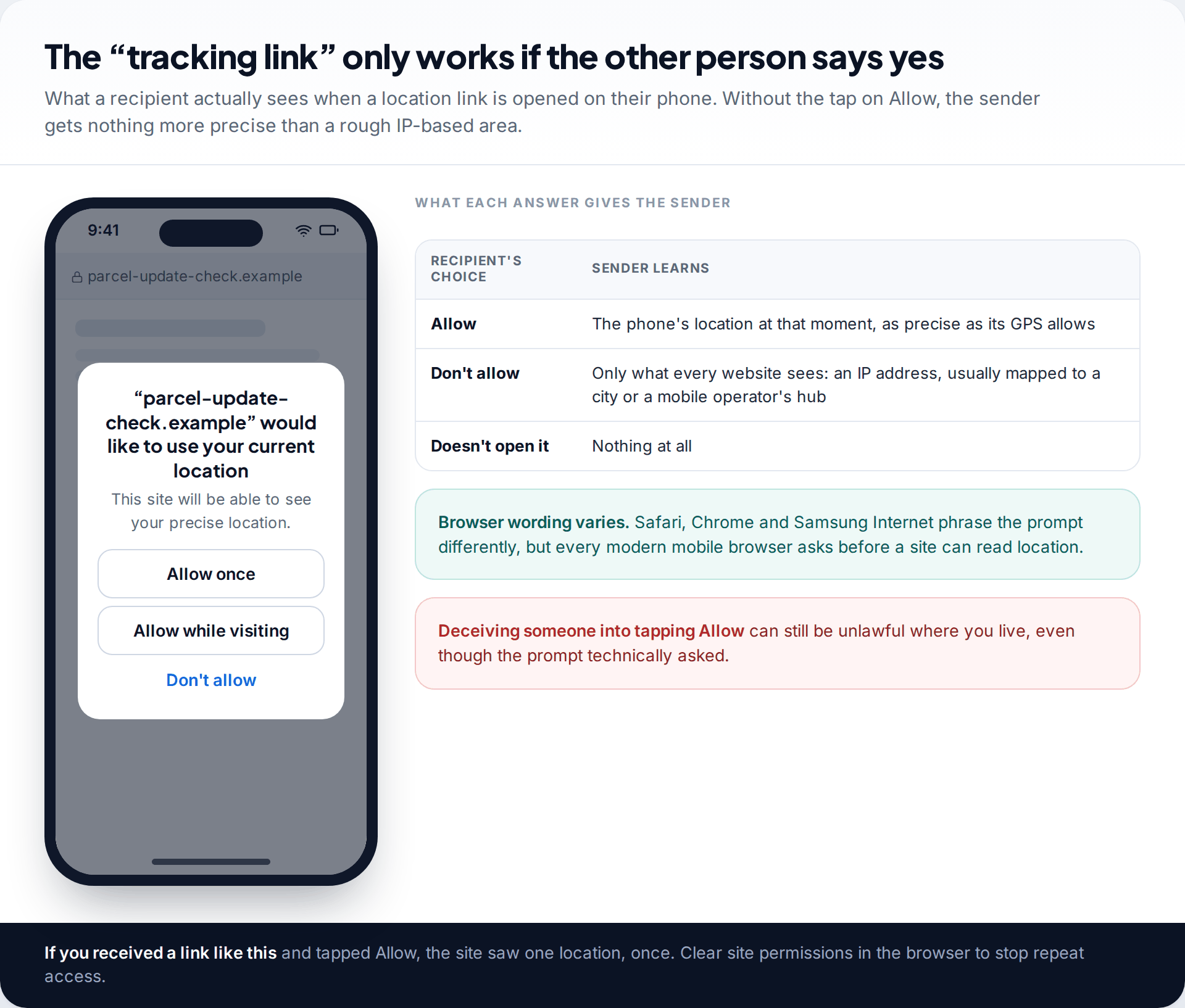
Some services offer to send the target a text containing a link, disguised as a parcel update, a photo or a prize. If the recipient opens it, the page asks the browser for location. Every modern mobile browser then shows its own permission prompt, which the website cannot suppress. Only if the person taps Allow does the site receive a position, and only the position at that moment.
So even this route depends on the phone owner acting. If they ignore the link or tap Don’t allow, the sender gets what every website gets: an IP address, which usually maps to a city or to the operator’s network hub rather than a street. Tricking someone into approving the prompt is still deception, and depending on where you live it may breach laws on computer misuse, harassment or data protection.
If you think a link like this was used on you, open your browser’s site settings, remove location permission for any site you don’t recognise, and treat the sender’s number with suspicion. If you are worried someone is following your movements more broadly, our guide on stopping someone tracking your location goes through every route to close.
When carrier location did leak
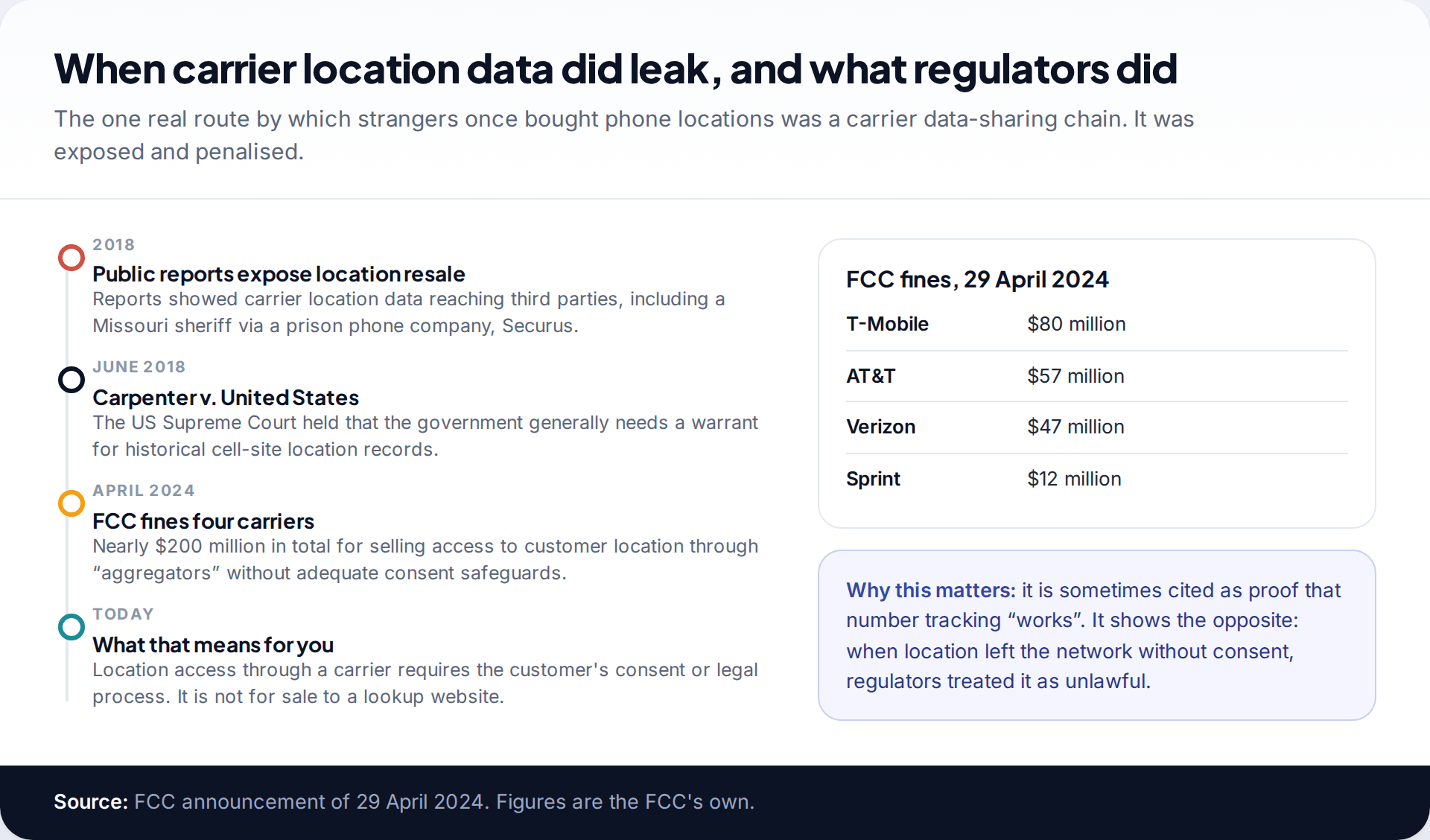
There was a period when strangers could buy a phone’s location, and it is worth knowing about because it gets misquoted. In 2018, reports showed that US carriers had been selling access to customer location through intermediaries called aggregators, which resold it onwards. One case involved a Missouri sheriff obtaining locations through a prison phone company.
In April 2024 the FCC fined AT&T, Sprint, T-Mobile and Verizon nearly $200 million between them for failing to protect that information and for relying on downstream companies to obtain consent. The lesson is not that number tracking works. It is that location leaving a carrier without consent is treated as unlawful, and the regulator’s position is now on record.
Red flags, and what to do if you already paid
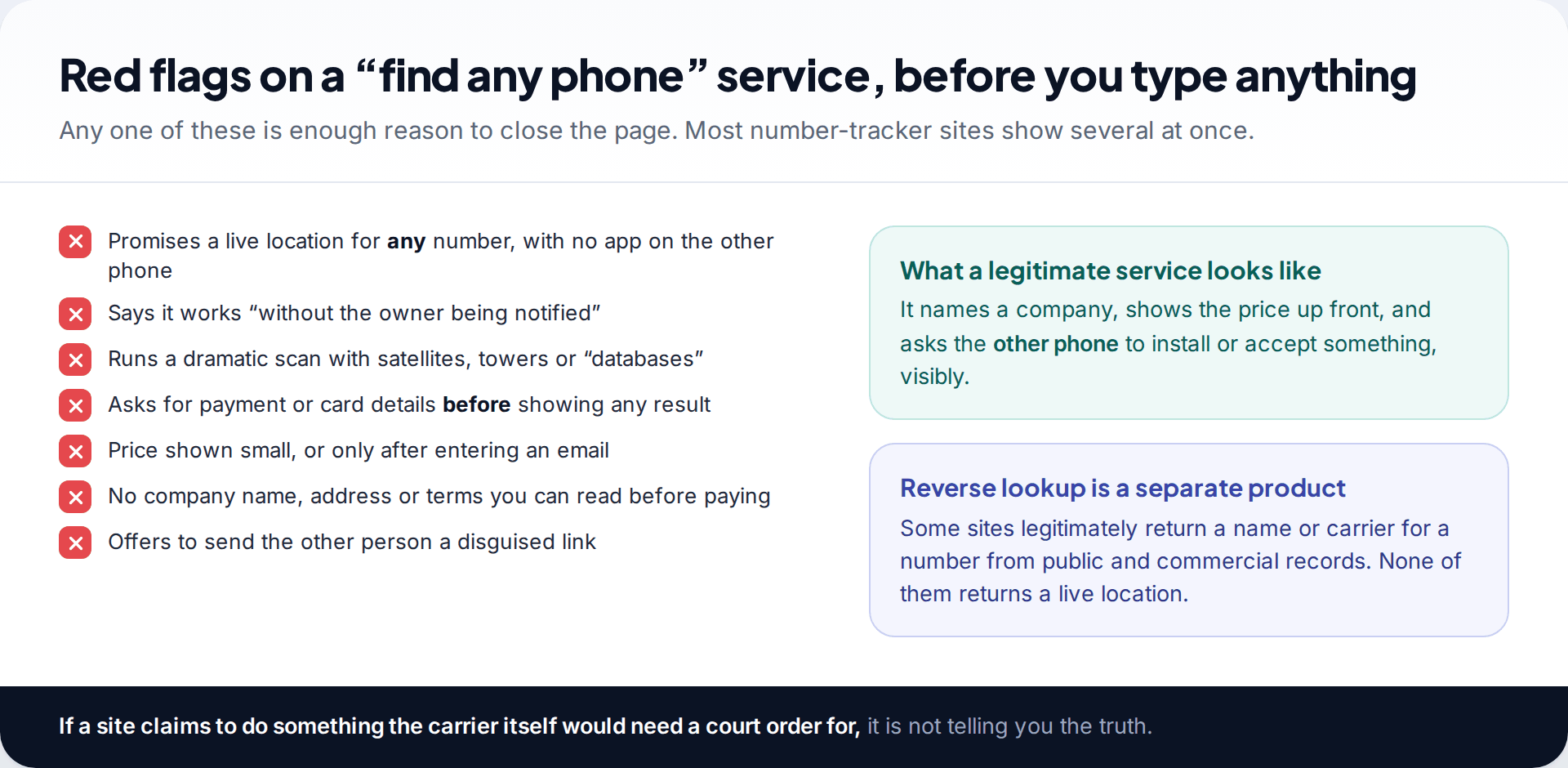
A handful of signs identify these sites quickly. They promise a live location for any number with nothing installed on the other phone. They say the owner won’t be notified. They ask for payment before showing anything, hide the price, and name no company you could complain to. Legitimate location products do the opposite: they name the company, show the price, and require the other person to install something or accept an invitation.
Reverse phone lookup deserves a separate mention. Some sites legitimately compile names and carriers from public and commercial records, and in some countries that is lawful. It still does not produce a live location, and quality varies a great deal.
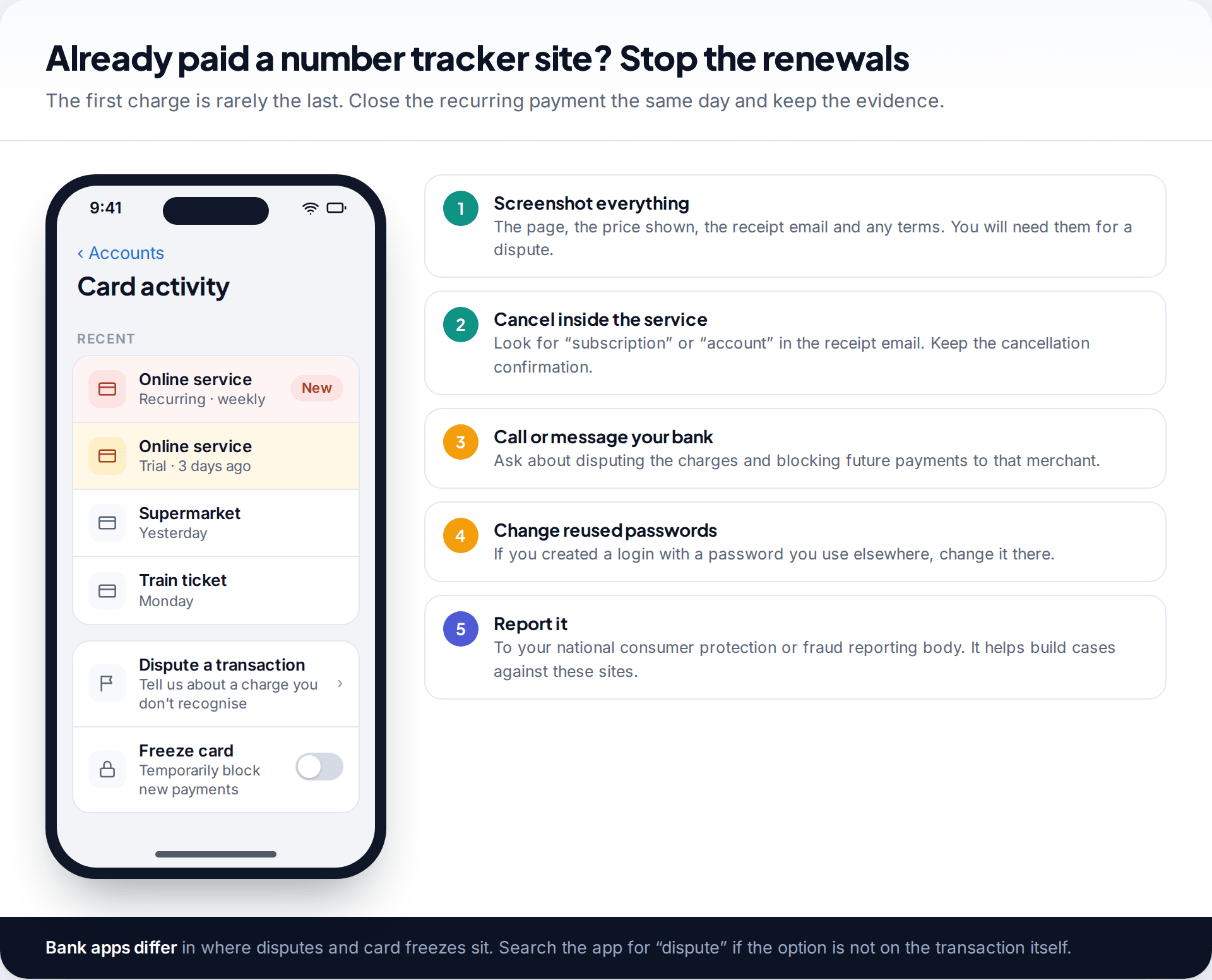
If you already paid, act the same day. Screenshot the page, the price and the receipt. Cancel through the service if there is a way to, and keep the confirmation. Then contact your bank or card issuer about disputing the charges and blocking future payments to that merchant. Change any password you reused when signing up, and report the site to your national consumer protection or fraud body.
What to do instead
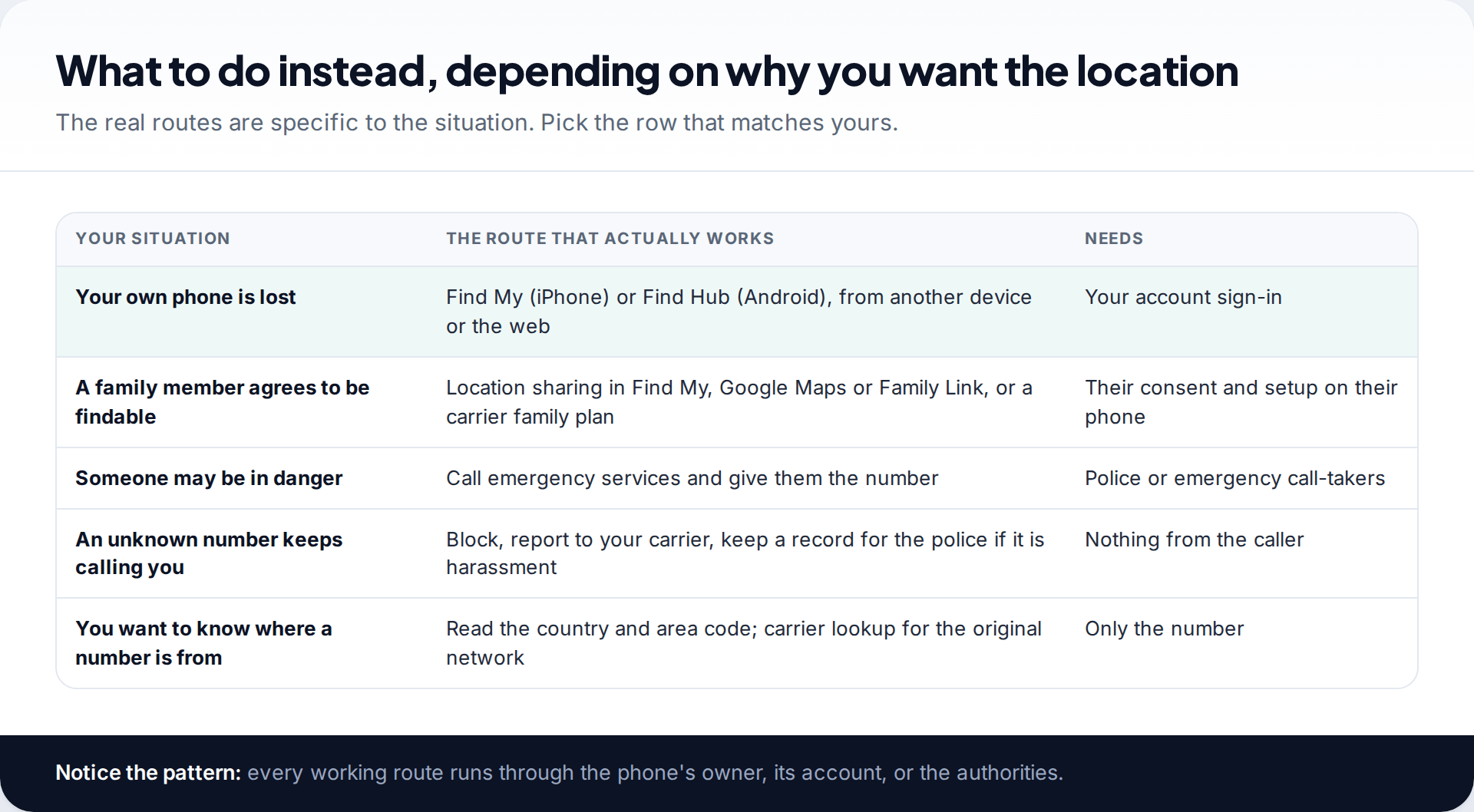
The honest answer depends on why you want the location. For your own lost phone, Find My on an iPhone or Find Hub on Android locates it from any browser, using your account rather than your number. For a family member, the working options are consent-based sharing that they turn on themselves; our guide to the phone tracking methods that actually work compares them. If someone may be in danger, call the emergency services and give them the number. If a stranger keeps calling you, block and report the number rather than trying to trace it yourself; persistent harassment is a police matter, and the police can go to the carrier.
For people worried about the reverse, the same facts apply. Someone who only has your number cannot see where you are. The realistic risks are different: location sharing you once turned on and forgot, a shared family account, or software on your phone.
How this page was put together
We checked the technical and legal points against primary sources in September 2026: the FCC’s pages on E911 location and its April 2024 enforcement announcement, the US Supreme Court’s Carpenter opinion, Google’s description of Android Emergency Location Service, Verizon’s family-locator help pages and the UK numbering plan. We looked at how current number-tracker sites describe themselves but did not enter numbers, create accounts or pay any of them, and we have not named any.
Laws on location data differ by country, so treat the legal examples as illustrations rather than advice for your jurisdiction. Our editorial standards page explains how we source and correct guides.
Common questions
Can someone track my location with my phone number?
Not on its own. They would need your carrier’s cooperation, which requires legal process, or your own action, such as tapping Allow on a location request or accepting a location-sharing invitation.
Can police track a phone by its number?
Yes, through the carrier and with the legal authority their country requires. They cannot do it through a public website any more than you can.
Do free phone number tracker websites work?
They can show the country, original carrier and sometimes the area of a landline. They cannot show where a mobile phone is. Many “free” ones end in a payment or data-collection gate.
Can I track a number by sending a text?
A plain text reveals nothing about location. Only a link that the recipient opens and then approves in the browser’s location prompt can return a position.
Why does the location on a lookup site show a different city?
Because it shows where the number was issued or where the operator’s network hub is. Mobile numbers stay the same when their owner moves.
Can a carrier tell me where my child’s phone is?
Many carriers sell family locator services for lines on your own account. Without an app on the child’s phone the result may be approximate; with it, it is more precise, and your child will know it is there.
The tools behind this guide. TheTruthSpy is a free parental control app for Android: GPS location tracker with geofencing, a screen time app with app limits, a website blocker and web filter, an SMS tracker and call tracker, and social media monitoring for the WhatsApp tracker, Instagram tracker, Snapchat tracker, Facebook Messenger tracker and Viber tracker. See the full parental control feature list, the free parental control pricing, or the download and setup guide.
Related guides
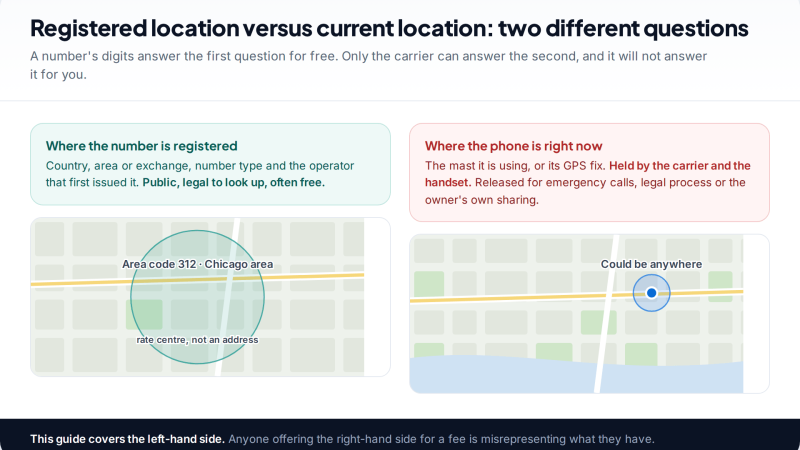
Where Is a Phone Number From? Legal Ways to Find Its General Location
You can legally work out where a phone number is registered from its country code, area code, number type and…
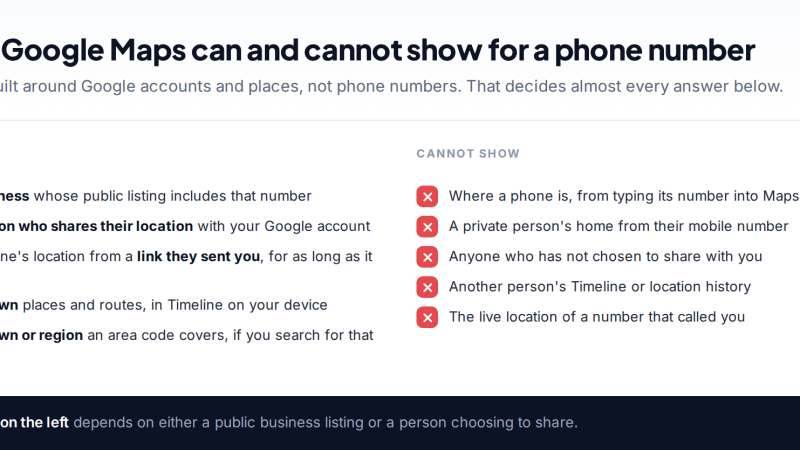
Finding a Phone Number’s Location on Google Maps: What Is Possible
Google Maps cannot look up where a phone number is. It shows people's location only when they share it with…
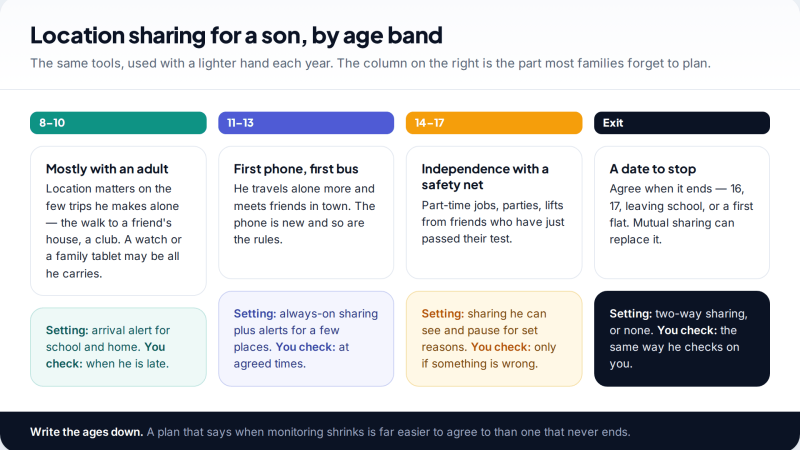
Tracking Your Son’s Phone Openly: A Setup He Agrees To
How to track your son's phone in a way he knows about and agrees to: what to use at 8–10,…
Free parental control app for Android
GPS tracking, screen time limits, web filtering, SMS and call monitoring — visible on your child's phone. Pair a phone in about ten minutes.
Android · Free to set up · Visible on your child's phone